Key takeaways
- Oil-immersed transformers generally cost less and run more efficiently at a given rating than dry-type equivalents.
- Cast-resin dry-type transformers have no flammable liquid to contain, which simplifies fire safety in occupied buildings.
- IEC 60076-11 covers dry-type transformers; IEC 60076-1 is the general oil-immersed and shared base standard.
- Dry-type units are typically specified indoors, in basements, and in high-occupancy or environmentally sensitive locations.
- Compact substations often pair an oil-immersed transformer in an outdoor enclosure to combine cost efficiency with contained fire risk.
Oil-immersed and cast-resin dry-type transformers both deliver the same electrical function — stepping voltage between medium and low voltage — but differ enough in cost, losses, fire behaviour and footprint that the choice should be driven by installation location and risk tolerance rather than habit. Oil-immersed units generally win on cost and efficiency; dry-type units generally win on fire safety and indoor suitability. This guide compares both across the factors that actually decide a specification.
How each type works
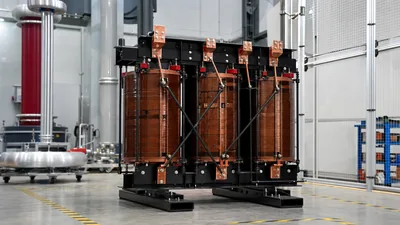
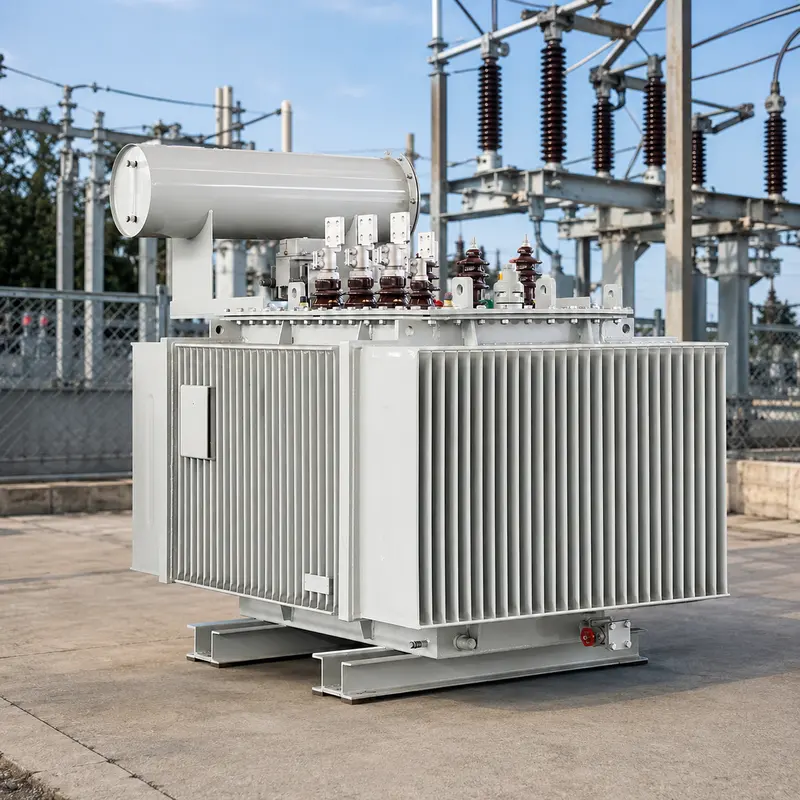
An oil-immersed transformer submerges the core and windings in mineral oil or a synthetic/natural ester fluid, which serves as both the dielectric (insulating) medium and the primary heat transfer medium, circulating by natural convection (ONAN) or with fans and pumps (ONAF/OFAF) to a radiator bank. A cast-resin dry-type transformer encapsulates the windings in an epoxy resin insulation system with no liquid dielectric, relying on air — natural (AN) or forced by fans (AF) — for cooling. Both are built to the shared general requirements of IEC 60076-1, with oil-immersed units additionally following the liquid-immersed parts of that series and dry-type units following IEC 60076-11.
Comparison table
| Factor | Oil-immersed | Cast-resin dry-type |
|---|---|---|
| Typical capital cost | Lower per kVA | Higher per kVA, typically 20-40% more |
| No-load and load losses | Generally lower for a given rating | Generally higher for a given rating |
| Fire safety | Flammable liquid present; requires oil containment, fire barriers or bunding | No flammable liquid; self-extinguishing resin system (commonly F1 class) |
| Footprint | Compact core/coil, but needs oil containment/bund space and radiator clearance | Slightly larger core/coil for equivalent cooling, but no bund required |
| Maintenance | Periodic oil sampling, dielectric testing, leak checks | Lower routine maintenance; periodic cleaning and insulation checks |
| Overload capability | Good short-term overload with oil as thermal buffer | More limited short-term overload margin |
| Environmental exposure | Suited to outdoor, harsh, and humid environments | Sensitive to heavy dust and condensation without enclosure protection |
| Service life | Typically long, dependent on oil condition and loading | Typically long, dependent on thermal cycling and environment |
| Typical locations | Outdoor substations, utility distribution, industrial yards | Indoor plant rooms, basements, hospitals, shopping centres, high-rises |
Cost and losses
For a given kVA rating, an oil-immersed transformer is typically less expensive to manufacture because oil is a more efficient insulating and cooling medium than air, allowing a smaller, lighter core and coil assembly. This also tends to translate into lower no-load losses (core losses, present continuously) and lower load losses (winding losses, present under load) than an equivalently rated dry-type unit, which matters over a 20-30 year service life where loss cost can exceed the purchase price. Where lifetime energy cost dominates the buying decision — for example, a utility feeder with high load factor — oil-immersed is usually the more economical choice on total cost of ownership, not just capital cost.
Fire safety
This is the factor most likely to override cost. Oil-immersed transformers contain a flammable liquid — mineral oil has a flash point in the region of 140-160 degrees C, and even less-flammable ester fluids, while safer, are not non-combustible. Installations therefore typically require oil containment (a bund or drainage pit sized to the full oil volume), adequate fire separation from occupied spaces, and in many jurisdictions a fire-rated enclosure or building separation distance.
Cast-resin dry-type transformers carry no such liquid inventory. Built correctly, the resin insulation system is self-extinguishing and does not sustain combustion once an external ignition source is removed — commonly classified F1 under IEC 60076-11’s environmental and fire behaviour scheme. This is why dry-type is the default specification for transformers located inside occupied buildings: hospital basements, shopping centre plant rooms, high-rise service risers, and any location where oil containment and fire separation distances cannot practically be achieved. Local fire and building codes should always be checked, since requirements and acceptable installation distances vary by jurisdiction.
Footprint and installation
Oil-immersed transformers need clearance for radiators or cooling fins and, critically, space for an oil containment bund sized to hold the full oil charge plus firefighting water in the event of a fire — this bund footprint is often overlooked in early layout planning and can be larger than the transformer itself. Dry-type transformers avoid the bund requirement entirely, which can make them the more space-efficient choice in a tightly constrained indoor plant room even though the core and coil assembly itself is often physically larger than an oil-immersed equivalent at the same rating.
Maintenance and overload behaviour
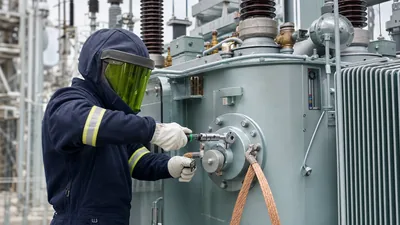
Oil-immersed transformers require a maintenance programme that includes periodic oil sampling (dissolved gas analysis, moisture, dielectric strength) and topping up or filtering as needed; the oil itself also gives these units strong short-term overload capability, since it acts as a thermal buffer absorbing heat before winding temperature rises critically. Dry-type transformers need comparatively little routine maintenance — no oil to sample, no leak risk — but have a smaller thermal buffer, so overload margins above nameplate rating are typically more limited and should be confirmed against manufacturer data rather than assumed.
Environmental considerations
Oil-immersed transformers tolerate outdoor exposure, humidity and contamination well, provided the enclosure and bushings are correctly rated, which is why they dominate outdoor utility and industrial distribution. Dry-type transformers are sensitive to heavy dust accumulation and condensation on the winding surface if not adequately enclosed or climate-controlled, so indoor installations should account for ventilation and, in humid climates, anti-condensation heating.
Hybrid cases: compact substations
Compact, prefabricated substations often make the type decision for you by location. An outdoor pad-mounted or box-type compact substation commonly uses an oil-immersed transformer, since the enclosure itself provides weatherproofing and a degree of fire and access risk management, and the cost/efficiency advantage of oil is retained. Where the same compact substation is sited against or inside an occupied building — a retail unit, a residential basement — a dry-type transformer is frequently specified instead, or the enclosure is designed with additional fire separation to accommodate an oil-filled unit safely. MARS supplies both transformer types for use in compact and box-type substations, so the enclosure and transformer type can be matched to the site constraint rather than compromising on either.
Total cost of ownership
Capital cost is only part of the specification decision. A transformer’s lifetime cost combines purchase price, no-load losses (paid for continuously, whether the transformer is loaded or not), load losses (paid for in proportion to the square of load current), and maintenance. Because oil-immersed units generally exhibit lower losses at a given kVA rating, the gap between the two types on total cost of ownership over a 20-30 year service life is typically wider than the gap in purchase price alone — an oil-immersed transformer that costs 15-20% less to buy can end up 25-30% cheaper over its service life once loss cost at typical utility electricity rates is included, though the exact figure depends heavily on load factor and local energy prices and should be calculated for the specific project rather than assumed. Where a project’s evaluation criteria weight capitalised losses heavily — common in utility and large industrial procurement — this favours oil-immersed wherever the fire safety case allows it.
Retrofit and replacement considerations
Replacing an existing transformer, rather than specifying one for a new building, adds constraints that can override the general cost/fire-safety trade-off above. An existing oil-immersed unit being replaced in a location that was acceptable under an older fire code may not meet a current code if requalified today, making a like-for-like oil-immersed replacement impractical without additional fire engineering — in these cases a dry-type replacement, even at higher cost, can be the only route to a straightforward permit. Conversely, replacing a dry-type unit in a location with adequate fire separation and existing oil containment infrastructure already in place may make switching to oil-immersed viable for a lower long-term cost, provided the enclosure and bund can be reused or economically adapted. Any replacement project should reassess the site against current fire code and enclosure requirements rather than simply matching the outgoing unit’s type.
Making the decision
In practice, the specification usually comes down to three questions: Is the installation indoors or in an occupied building? If yes, dry-type is the default unless fire engineering demonstrates otherwise. Does total lifetime cost, including losses, matter more than capital cost? If yes, and the site is outdoor or industrial, oil-immersed is usually more economical. Is the environment harsh, humid or dusty without climate control? If yes, oil-immersed’s sealed construction is generally more tolerant. Reviewing these against the specific site, rather than defaulting to one type across a whole project, produces the more defensible specification.
How MARS can help
MARS manufactures both oil-immersed and cast-resin dry-type distribution transformers from 5 kVA to 31,500 kVA at 3-35 kV, built to IEC 60076-1 and IEC 60076-11, with insulation class, winding material and enclosure IP rating configurable to the installation. We can advise on type selection for a specific site and supply either transformer type inside a matching compact substation enclosure. Contact us or request a quote with your site details for a type comparison.
Frequently asked questions
Is oil-immersed or dry-type transformer better?
Neither is universally better — the choice depends on location and risk. Oil-immersed units are typically more efficient and lower cost per kVA, favouring outdoor and utility use. Dry-type units avoid flammable liquid, favouring indoor, high-occupancy or environmentally sensitive sites.
Can dry-type transformers be installed indoors without a fire barrier?
Cast-resin dry-type transformers carry a self-extinguishing classification (commonly F1 per IEC 60076-11) and generally require less extensive fire protection than oil-filled units indoors, but local fire codes and building regulations should always be checked, as requirements vary by jurisdiction and building occupancy.
Why are oil-immersed transformers more efficient?
Mineral or ester oil is a more effective heat transfer and dielectric medium than air, allowing a more compact core and winding design with lower losses for a given kVA rating and temperature rise, compared with air-cooled cast-resin construction.
What standard applies to dry-type transformers?
IEC 60076-11 covers dry-type transformers specifically, addressing environmental, climatic and fire behaviour classifications, while IEC 60076-1 provides the general requirements shared with oil-immersed transformers.
Do dry-type transformers need less maintenance than oil-immersed?
Dry-type transformers generally need less routine maintenance because there is no oil to sample or filter and no risk of oil leakage, though periodic cleaning of windings and insulation checks are still required. Oil-immersed units need periodic oil testing and top-up as part of a maintenance programme.
Which transformer type suits a compact substation?
Both types are used in compact substations. Oil-immersed transformers are common in outdoor box-type or European-style compact substations where the enclosure itself manages fire and access risk; dry-type units are preferred where the substation sits inside or against an occupied building.
Tags: oil-immersed transformer dry-type transformer cast resin transformer transformer comparison IEC 60076