Key takeaways
- Single-phase pole-mounted transformers typically range 5-167 kVA; three-phase units typically range 25-500 kVA.
- CSP (completely self-protected) transformers integrate a fuse, lightning arrester and circuit breaker in one enclosure, suited to remote sites with limited maintenance access.
- Single Wire Earth Return (SWER) is a low-cost single-phase distribution method used for very long, lightly loaded rural spurs.
- Rural feeders are typically lightly loaded (often well under 50%), so no-load loss weighs heavily in transformer selection.
- Pole loading (transformer weight plus wind and ice load) must be checked against the pole class before mounting a given kVA rating.
Pole-mounted transformers remain the standard method of stepping medium-voltage rural feeders down to utilisation voltage across most electrification programmes, chosen for lower installed cost than pad-mounted or substation alternatives where load density is low and access is limited. Selecting between single-phase and three-phase units, and sizing them correctly against a genuinely diversified rural load, has a direct effect on both cost per connection and long-term losses.
Single-phase pole-mounted transformers
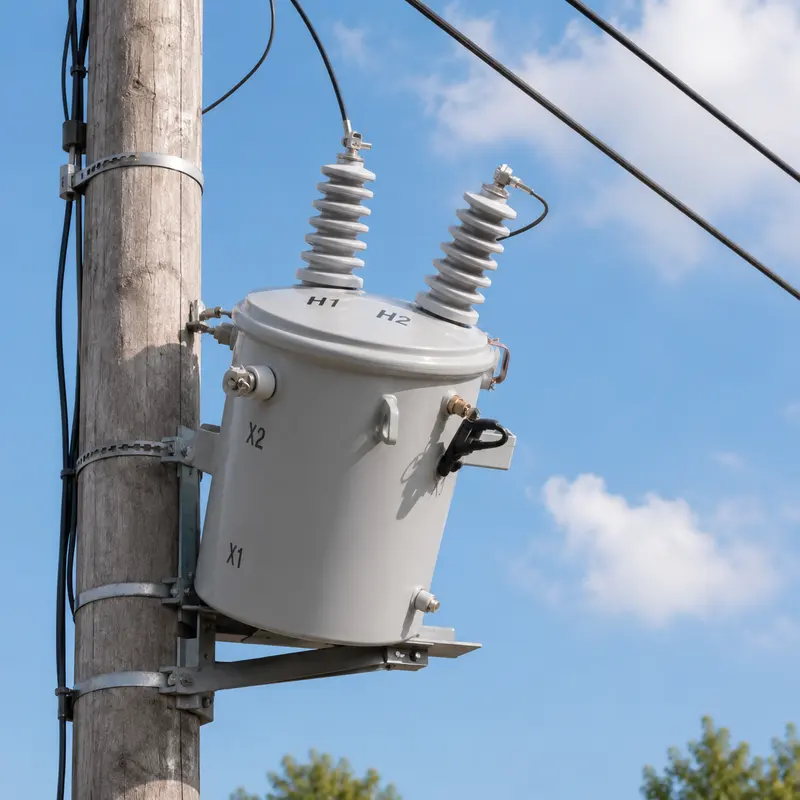
Single-phase pole-mounted transformers, typically ranging from 5 kVA up to around 167 kVA, are the standard choice for scattered rural connections — individual homesteads, small farms, or a short spur off a main three-phase line. They are lighter, cheaper per unit, and require only a single conductor plus neutral/earth return from the primary line, reducing both material cost and pole loading compared with a three-phase alternative for the same aggregate demand. Because rural single-phase loads are typically lighting, small appliances, and occasionally single-phase pumps, capacity requirements per connection are modest, and diversity between connections (not everyone drawing peak load simultaneously) allows one transformer to serve multiple households economically.
Three-phase pole-mounted transformers
Three-phase pole-mounted transformers, typically ranging from 25 kVA to 500 kVA, are used where load justifies the extra cost: village centres with mixed commercial and residential load, agricultural sites needing three-phase motors (irrigation pumps, mills, cold storage), or feeders serving enough aggregated single-phase demand that balancing across three phases at a common transformer is more efficient than several single-phase units. Three-phase units also simplify future load growth, since three-phase service can be extended to new connections without adding a second single-phase transformer.
| Factor | Single-phase | Three-phase |
|---|---|---|
| Typical range | 5-167 kVA | 25-500 kVA |
| Best suited to | Scattered, low-density rural connections | Villages, agricultural/industrial loads needing motors |
| Conductors needed | Single phase + neutral/earth | Three phases (+ neutral, typically) |
| Relative pole loading | Lower | Higher |
| Cost per connection (low density) | Generally lower | Generally higher |
| Supports three-phase motor loads | No | Yes |
CSP (completely self-protected) transformers
Completely self-protected (CSP) transformers integrate protection components that would otherwise require separate pole-mounted equipment: an internal weak-link or bayonet fuse to clear internal faults, a lightning (surge) arrester connected across the primary bushing to protect against transient overvoltage, and, on many designs, a low-voltage circuit breaker with overload-sensing that can automatically reclose after a transient secondary fault. This integration reduces the number of separate devices that must be mounted, wired, and maintained on the pole — a significant advantage at remote rural sites where maintenance visits are infrequent and skilled technician access is limited. CSP transformers are widely favoured for exactly the kind of dispersed rural electrification work where distance and access cost dominate the maintenance economics.
Surge arresters and fuse cut-outs
Even where a CSP transformer is not used, rural pole-mounted installations require lightning protection given the greater exposure of long overhead rural lines to direct and induced lightning strikes. A surge (lightning) arrester rated for the system’s nominal voltage is connected as close to the transformer primary bushing as practical, with a short, low-inductance earth connection to be effective. A fuse cut-out (drop-out fuse) on the primary side provides overcurrent and fault isolation, protecting both the transformer and the upstream feeder, and allows a lineman to visually confirm isolation before working on the transformer — an important safety feature on feeders with limited remote switching.
SWER (Single Wire Earth Return)
Single Wire Earth Return (SWER) is a distribution method using one overhead conductor with the earth itself as the return path, eliminating the second conductor a conventional single-phase line would need. SWER is used specifically for very long, lightly loaded rural spurs — extending supply to remote settlements where the cost of a conventional two-wire line over that distance would not be justified by the load served. SWER requires an isolating transformer at the point where it connects to the main three-phase network, and specific earthing design at both ends, but has enabled electrification of dispersed rural areas that would otherwise remain uneconomical to serve.
Medium-voltage network levels
Rural distribution networks feeding pole-mounted transformers commonly operate at 11 kV, 22 kV, or 33 kV, with the choice generally reflecting feeder length and expected load growth: longer rural feeders favour higher primary voltages (22 kV or 33 kV) to limit voltage drop and reduce conductor cross-section for a given power transfer, while shorter, denser feeders closer to a substation may remain at 11 kV. The pole-mounted transformer’s primary winding and bushings must be rated to match the network voltage class in use.
Mounting and pole loading
Pole-mounted transformer weight, together with wind loading on the tank and any ice loading in applicable climates, must be checked against the structural rating (class) of the pole before mounting a given kVA rating. Larger three-phase units, in particular, may require a stronger pole class, a two-pole platform mounting, or additional guying, especially at line angles or dead-ends where mechanical loading from conductor tension adds to the transformer’s own weight. Mounting brackets should match the transformer’s specified bracket dimensions, and clearances to conductors, ground, and any nearby structures should follow the applicable national electrical code or utility construction standard.
Losses on lightly loaded rural feeders
Rural feeders are frequently loaded well under 50% of the transformer’s rated capacity, especially outside peak evening hours, meaning no-load (core) loss — present continuously regardless of load — often represents a disproportionate share of total energy lost compared with load (copper) loss, which only rises with current squared. This is discussed in more depth in our article on transformer losses and total cost of ownership, but the practical implication for rural programmes is that selecting a lower no-load-loss design (including amorphous-core options) can matter more for lifetime cost than it would on a heavily loaded urban transformer.
Cooling and enclosure considerations for rural sites
Pole-mounted transformers are almost universally naturally cooled (ONAN or, for smaller dry-type variants, AN), since forced cooling equipment would add maintenance burden and a failure point at exactly the remote sites where technician access is most limited — the entire design philosophy of rural pole-mounted equipment favours simplicity and long unattended service intervals over the higher power density that forced cooling would allow. Tank and bushing design should account for the local environment: coastal or high-humidity sites benefit from corrosion-resistant tank coatings and sealed bushings, while sites with high ambient temperature or intense solar loading may need a small derating margin relative to the nameplate rating, or a slightly larger unit than the calculated load would otherwise require, to keep hot-spot temperature within the insulation class limit across the full range of site conditions.
Maintenance access and service life
Because rural pole-mounted transformers are visited infrequently compared with substation equipment, service life expectations and maintenance planning differ from urban distribution assets. Sealed, maintenance-free bushings and gaskets, hermetically sealed tanks (where oil expansion is accommodated without a conservator and its associated breather maintenance), and corrosion-resistant fittings all reduce the frequency of intervention needed over a 20-25 year service life. Where a conservator-type tank is used instead, silica gel breathers require periodic replacement to keep moisture out of the oil, which is a meaningful planning consideration for programmes covering large numbers of dispersed rural sites, since breather neglect is one of the more common causes of premature oil degradation on rural transformer fleets.
Worked example: sizing for a small village
Consider a village of 40 households plus a small mill, to be served from a three-phase 11 kV line.
- Average household connected load: 1.5 kVA (lighting, small appliances), with a diversity factor of 0.4 applied across 40 connections (not all peak simultaneously): 40 x 1.5 x 0.4 = 24 kVA.
- Mill load (three-phase motor): 15 kVA, with a diversity/utilisation factor of 0.7 applied since it does not always run at full load: 15 x 0.7 = 10.5 kVA.
- Total diversified demand: approximately 34.5 kVA.
- Applying headroom for growth (commonly 20-30% for a rural programme with anticipated new connections): 34.5 x 1.25 ≈ 43 kVA.
A standard 50 kVA three-phase pole-mounted transformer would be selected, giving margin above the calculated diversified demand while remaining a standard, cost-effective rating rather than a custom size. Our transformer sizing calculator can help run this kind of diversified-load calculation for a specific village or feeder layout.
Summary
Choosing between single-phase and three-phase pole-mounted transformers for rural electrification comes down to load density, whether three-phase motor loads are present, and the economics of conductors and poles over the feeder’s length. CSP units, surge arresters, and correctly rated fuse cut-outs reduce the maintenance burden at remote sites, while realistic diversified-load sizing and attention to no-load loss keep both capital and running cost proportionate to actual rural demand.
How MARS can help
MARS manufactures single-phase pole-mounted transformers from 5 kVA to 167 kVA and three-phase units up to 500 kVA, with CSP configurations, copper or aluminium windings, and voltage ratios configurable for 11 kV, 22 kV, or 33 kV primary networks. Designs follow IEC 60076 with ANSI-style variants available for markets that require them. To discuss sizing and configuration for a rural electrification programme, see our pole-mounted transformer range or request a quote.
Frequently asked questions
What size pole-mounted transformer is used for rural electrification?
Single-phase pole-mounted transformers for rural use typically range from 5 kVA to 167 kVA, while three-phase units typically range from 25 kVA to 500 kVA. The correct size depends on the number of connections served, diversified demand, and expected load growth over the transformer's service life.
What is a CSP transformer?
A completely self-protected (CSP) transformer integrates an internal fuse or weak-link protection, a lightning (surge) arrester, and often a low-voltage circuit breaker within the transformer tank or its mounting bracket, reducing the external switchgear needed at remote pole locations with limited maintenance access.
What is SWER and when is it used?
Single Wire Earth Return (SWER) is a rural distribution method using a single overhead conductor with the earth (ground) as the return path, avoiding a second conductor. It suits very long, lightly loaded spurs serving scattered rural connections where a full two- or three-wire line would not be economically justified.
Should a rural feeder use single-phase or three-phase pole-mounted transformers?
Single-phase units suit scattered low-density loads such as individual homesteads or small farms, at lower cost per connection. Three-phase units suit villages, small industrial or agricultural loads (irrigation pumps, mills) needing three-phase motors, or feeders with enough aggregated load to justify the extra conductor and equipment cost.
Why do rural transformers often have higher relative losses than urban ones?
Rural feeders typically run at low average loading, often well under 50% of transformer rated capacity, so no-load (core) loss becomes a larger proportion of total energy lost relative to load (copper) loss, unlike heavily loaded urban transformers where copper loss dominates.
What voltage levels are common for rural pole-mounted transformer primaries?
Common medium-voltage primary levels for rural pole-mounted transformers are 11 kV, 22 kV, and 33 kV, with higher primary voltages generally used for longer feeder runs to reduce voltage drop and conductor size for a given load.
Tags: pole-mounted transformer rural electrification single-phase transformer CSP transformer SWER