Key takeaways
- A certified transformer laboratory provides the controlled dielectric, thermal, and electromagnetic environment required to validate performance against IEC 60076 and IEEE C57.12.00 standards.
- Partial discharge testing bays require electromagnetic shielding (Faraday cages) to maintain background ambient noise levels strictly below 2 pC to 5 pC.
- Dielectric fluid diagnostics performed in-house or by external transformer oil testing companies require gas chromatography to detect fault gases at concentrations below 1 ppm.
- Loss measurement systems in a high-voltage test bay must use precision capacitive voltage dividers and current comparators capable of maintaining an overall phase angle error under 1 minute of arc (0.29 mrad) at low power factors.
- Factory acceptance testing inside a transformer laboratory verifies that total measured losses fall within the permissible standard tolerances (+10% on total losses per IEC 60076-1 Table 1).
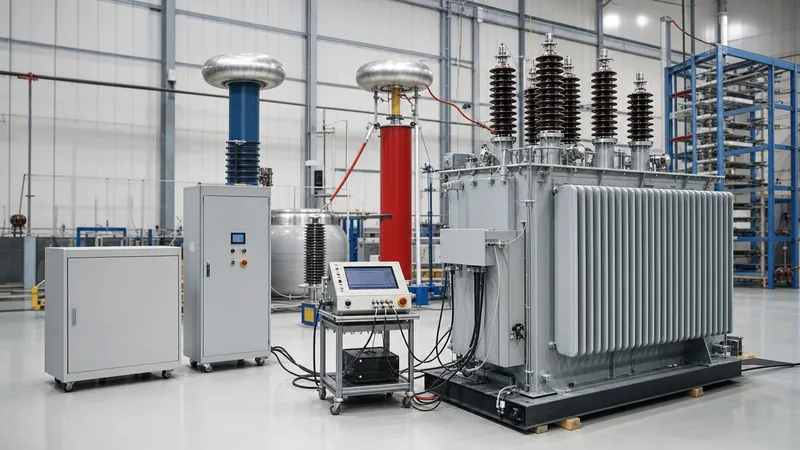
Quick answer: A transformer laboratory is a specialised engineering facility equipped with shielded high-voltage test bays, precision power analysers, and chemical diagnostic instrumentation designed to verify transformer insulation integrity, winding losses, and operational parameters against international standards like IEC 60076 and IEEE C57.12.00.
High-voltage transformers require rigorous testing to ensure reliability and safety before energisation.
Tags: transformer laboratory transformer oil testing companies dielectric testing routine transformer tests factory acceptance testing