Key takeaways
- National Electrical Code (NEC) 300.4(G) mandates an insulating surface, such as a plastic bushing, for raceways entering an enclosure with conductors sized 4 AWG (21.2 mm²) or larger.
- Engineered plastic conduit bushings prevent conductor insulation abrasion caused by mechanical vibration, thermal expansion, and cable pulling tension at raceway terminations.
- High-grade thermoplastic bushings manufactured from polypropylene or flame-retardant polyamide (nylon) typically carry UL 94 V-0 or V-2 ratings and operating limits from 105°C to 150°C.
- Trade sizes for conduit bushings span from 1/2 inch (16 mm metric designator) up to 6 inches (155 mm metric designator), matched to NPT, NPSM, or ISO metric conduit threads.
- Proper torque specification during installation prevents cracking rigid plastic flanges while ensuring locknuts secure the conduit body firmly to enclosure entry plates.
Quick answer: A plastic bushing electrical conduit fitting is a threaded insulating ring installed on the end of a rigid conduit or connector inside an electrical enclosure to provide a smooth, rounded edge that prevents incoming power cables from snagging, abrading, or shearing against sharp metal edges.
In industrial electrical infrastructure, cable terminations inside distribution transformers, switchgear cable compartments, and auxiliary control panels face continual physical forces. Mechanical vibrations transmitted from transformer core-and-coil assemblies, alongside long-term thermal expansion and cyclic load currents, cause conductors to flex continually at enclosure entry points. If conductors rest against bare metal conduit threads or sharp knockout rims, the cable jacket and conductor insulation deteriorate over time, culminating in catastrophic phase-to-earth faults. Selecting and installing the correct plastic bushing electrical conduit fitting ensures compliance with regulatory codes, protects conductor integrity under dynamic mechanical stresses, and maintains dielectric insulation levels across the equipment life cycle.
What is a Plastic Bushing Electrical Conduit Fitting?
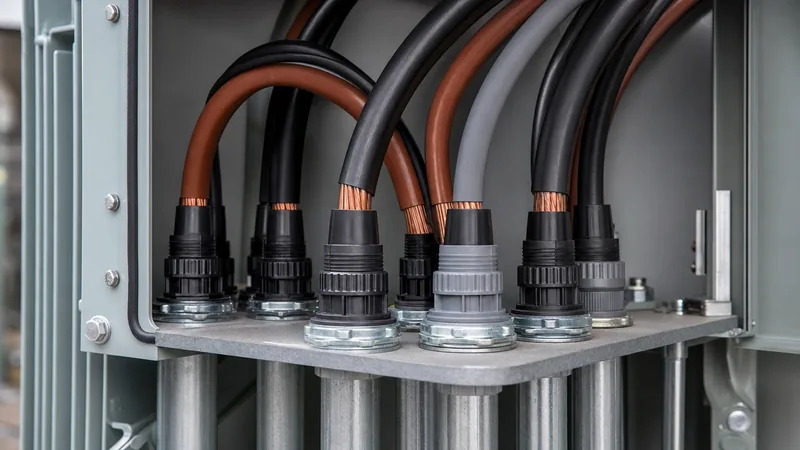
A plastic bushing electrical conduit fitting is an internally threaded, injection-moulded component screwed onto the exposed male threads of rigid metal conduit (RMC), intermediate metal conduit (IMC), or transition adapters inside an equipment termination cabinet. Its primary function is to transform the jagged, cut metallic edge of a raceway into a smooth, radiused entry path for low-voltage (LV) and medium-voltage (MV) power cables.
Unlike simple snap-in grommets, threaded plastic bushings electrical assemblies interlock directly with the conduit raceway. When paired with an external and internal locknut on an enclosure wall, the plastic bushing caps the final thread engagement, preventing conductor chaffing during initial wire pulling and throughout ongoing operations. While primary high-voltage entries rely on specialised high-dielectric assemblies detailed in our transformer bushing engineering guide, raceway terminations at the marshalling box, neutral ground connection cabinet, and LV terminal chamber require compliant conduit-grade insulating bushings to satisfy fire, mechanical, and safety standards governed by UL 514B and IEC 61386.
NEC and IEC Code Requirements for Conduit Plastic Bushings
Conduit plastic bushings are mandatory under major international electrical codes whenever larger conductors enter an enclosure through a raceway. The National Electrical Code (NEC / NFPA 70) addresses this requirement directly under Article 300.4(G), titled Protection Against Physical Damage: Insulated Fittings.
Under NEC 300.4(G), raceways containing insulated conductors of 4 AWG (21.2 mm²) or larger entering a cabinet, box, or enclosure must be fitted with a substantial fitting providing a smoothly rounded insulating surface to protect conductors from abrasion, unless the design of the box or fitting inherently provides equivalent protection. The rule applies across standard distribution applications, whether terminating secondary feeders inside a pad-mounted transformer or wiring interlocks inside control cabinets. In addition, when raceways terminate at unthreaded knockouts, an insulating bushing must maintain its structural position even if locknuts loosen slightly under thermal cycling.
International standards mirror these mechanical protections. IEC 61386-1 clause 8 specifies that conduit terminations and fittings must be completely free from burrs, sharp edges, or projections likely to damage insulated conductors during drawing-in or operational service. For equipment destined for high-vibration environments, engineers frequently specify hybrid grounding bushings or high-impact engineering plastics to satisfy both grounding continuity and edge-insulation safety mandates, as outlined in our overview of electrical box bushing sizing and panel design.
Material Selection: Polypropylene, Nylon, and Thermoplastic Bushings
Material selection for electrical conduit plastic bushings dictates their maximum operating temperature, tensile strength, resistance to chemical degradation, and flammability performance. Industrial installations evaluate three primary polymer formulations:
- High-Impact Polypropylene (PP): Standard-grade thermoplastic offering economical isolation, excellent chemical resistance against battery acids and transformer oil splash, and a typical thermal rating of 105°C. Suitable for general-purpose indoor distribution boxes.
- Polyamide 6/6 (Nylon): High-strength engineered polymer with superior thread shear resistance, impact strength at low ambient temperatures (-40°C), and continuous temperature ratings up to 125°C or 150°C. Resists creep under constant mechanical tension.
- Glass-Filled Thermoplastic: Premium composite material exhibiting maximum dimensional stability under heavy conductor pull-through forces, widely deployed in heavy-duty utility switchgear compartments and industrial sub-stations.
Flame retardancy is verified under UL 94 standards, where bushings must achieve at least a V-2 rating, though project specifications for enclosed substations frequently mandate UL 94 V-0 (self-extinguishing within 10 seconds, no flaming drips). When deploying raceways into high-temperature dry-type equipment, such as a ventilated dry-type transformer enclosure where internal ambient temperatures often reach 80°C to 100°C under full kVA rating, standard 90°C fittings will distort, making 150°C-rated polyamide bushings mandatory.
Sizing and Dimensional Specifications for Plastic Bushings
Plastic conduit bushings are sized according to standard trade conduit designations matching rigid steel, aluminium, or intermediate conduit dimensions. The table below outlines dimensional parameters, knockout diameters, and typical tightening torques across standard industrial sizes.
| Conduit Trade Size (Inches) | Metric Designator (mm) | Enclosure Knockout Dia. (mm) | Conductor Threshold (NEC 300.4G) | Rated Max Temp (°C) | Recommended Torque (N·m) |
|---|---|---|---|---|---|
| 1/2" | 16 | 22.2 | Mandatory for ≥ 4 AWG | 105 – 150 | 3.5 – 4.5 |
| 3/4" | 21 | 27.8 | Mandatory for ≥ 4 AWG | 105 – 150 | 5.0 – 6.0 |
| 1" | 27 | 34.5 | Mandatory for ≥ 4 AWG | 105 – 150 | 7.0 – 8.0 |
| 1-1/2" | 41 | 49.2 | Mandatory for ≥ 4 AWG | 105 – 150 | 11.0 – 13.0 |
| 2" | 53 | 60.3 | Mandatory for ≥ 4 AWG | 105 – 150 | 15.0 – 18.0 |
| 3" | 78 | 88.9 | Mandatory for ≥ 4 AWG | 105 – 150 | 25.0 – 30.0 |
| 4" | 103 | 114.3 | Mandatory for ≥ 4 AWG | 105 – 150 | 35.0 – 40.0 |
When engineering high-amperage low-voltage secondary terminations, engineers often run multiple parallel conduits. A detailed engineering breakdown of heavy-duty secondary raceways is available in our 2 plastic bushing engineering guide, which examines throat clearances and pull calculations for multi-conductor runs.
Step-by-Step Installation Procedure on Transformer Cable Cabinets
Installing plastic conduit bushings correctly requires adherence to mechanical torque limits to prevent stripped internal polymer threads or cracked flanges. Field technicians must carry out the following procedure:
- Deburr and Prep Conduit Ends: Cut rigid conduit square and ream internal edges using a pipe reamer to remove metal swarf before presenting the pipe to the enclosure wall or gland plate.
- Secure the Raceway with Locknuts: Thread an exterior metallic locknut fully onto the conduit stem. Pass the conduit through the enclosure knockout, then thread an interior metallic locknut down firmly against the cabinet wall, sandwiching the enclosure steel.
- Hand-Thread the Plastic Bushing: Screw the plastic bushing electrical conduit fitting directly onto the exposed conduit threads extending beyond the interior locknut. Ensure the fitting starts cleanly without cross-threading.
- Final Seating and Torquing: Tighten the plastic bushing by hand until its base seats flush against the interior metal locknut. Using an open-ended spanner or non-marring strap wrench, tighten the bushing a further one-quarter to one-half turn (referencing torque values in the sizing table). Never use serrated pipe wrenches directly on plastic ribs as this introduces stress cracks.
- Conduct Cable Pulling: Pull insulated conductors into the cabinet. Ensure cables bend smoothly over the rounded lip of the plastic bushing without exceeding the manufacturer minimum cable bending radius (typically 8 to 12 times cable overall diameter under IEEE 1185).
Inspection Checklist for Field Verification and Commissioning
Site acceptance testing (SAT) and QA/QC punch lists require thorough verification of raceway entries. Commissioning engineers should verify the following five critical items before energising equipment:
- Code Compliance Check: Confirm that every raceway terminating conductors sized 4 AWG (21.2 mm²) or larger possesses an approved insulating bushing per NEC 300.4(G).
- Physical Integrity Inspection: Verify the plastic bushing has zero hairline fractures, thread stripping, or distortion caused by over-torquing during installation.
- Throat Clearance: Ensure the internal throat diameter of the plastic bushing does not obstruct the maximum allowable fill capacity defined under NEC Chapter 9, Table 1 (40% fill for three or more conductors).
- Temperature Compatibility: Confirm that the marked thermal rating on the bushing flange (e.g., 105°C or 150°C) meets or exceeds the rating of the enclosed cable insulation (typically 90°C XLPE/EPR) and the terminal cabinet ambient thermal rise.
- Earth Continuity Verification: Check that the metallic locknut beneath the plastic bushing provides sufficient mechanical bite into the painted or galvanised enclosure steel to ensure metallic bonding continuity under NEC 250.92, or verify that a dedicated bonding jumper is fitted if using plastic-insulated grounding bushings.
Next steps: specifying and sourcing
When specifying medium-voltage and low-voltage distribution transformers or integrated switchgear packages, ensure your project bill of materials (BOM) includes compliant conduit termination accessories. Specify exact trade sizes, temperature ratings (up to 150°C), and flammability certifications (UL 94 V-0) within your electrical schedule. Our engineering team assists project managers and EPC contractors worldwide in designing complete termination chambers, gland plates, and cable entry arrays tailored to national grid standards. Submit your single-line diagrams, conduit schedules, and equipment specifications directly through our quotation request page to receive a factory-direct technical proposal.
Frequently asked questions
What is the purpose of a plastic bushing on electrical conduit?
A plastic bushing provides a smooth, rounded surface over the sharp end of an electrical conduit raceway. It prevents conductor insulation from abrading, tearing, or shorting out during cable pulling and ongoing mechanical vibration.
When does the NEC require a plastic conduit bushing?
Under NEC 300.4(G), a conduit bushing or insulating fitting is mandatory whenever a raceway enters an enclosure containing insulated conductors of 4 AWG (21.2 mm²) or larger, unless the enclosure design inherently provides equivalent edge protection.
Can plastic bushings be used on metal conduit?
Yes, threaded plastic bushings are specifically engineered to screw onto the male threads of rigid metal conduit (RMC) and intermediate metal conduit (IMC) after an interior locknut has locked the pipe to the enclosure wall.
What is the difference between a standard plastic bushing and an insulated grounding bushing?
A standard plastic bushing is made entirely of non-conductive polymer solely to protect cable jackets, whereas an insulated grounding bushing features a metallic body, a grounding lug for bonding wire connection, and a plastic insulating throat insert.
What temperature rating should conduit plastic bushings have?
Standard plastic bushings are typically rated for 105°C, but applications near hot transformer tanks, dry-type coils, or industrial ovens require high-temperature polyamide (nylon) fittings rated for 125°C or 150°C.
Tags: plastic bushing electrical conduit plastic bushings electrical conduit fittings NEC 300.4 transformer terminations