Key takeaways
- Ring main units (RMUs) are compact, factory-sealed switching points for ring/loop distribution networks, typically 3-6 ways.
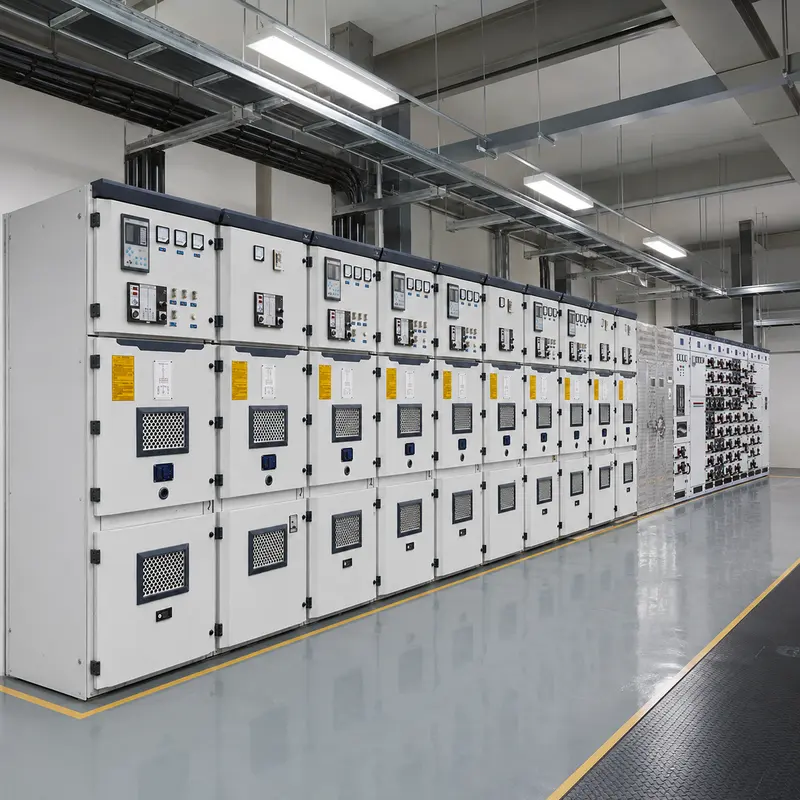
- Metal-clad switchgear per IEC 62271-200 offers withdrawable circuit breakers, individual metal compartments, and full LSC2 loss of service continuity.
- SF6 and air-insulated designs remain most common; solid-insulated (SIS) designs are gaining share where SF6 is being phased out.
- IEC 62271-200 defines loss of service continuity (LSC1/LSC2) and partition class (PM) categories that determine what can be worked on live.
- RMUs typically use fuse or ring-main-switch protection; metal-clad switchgear typically pairs breakers with numerical protection relays.
Choosing between a ring main unit (RMU) and metal-clad switchgear is one of the first decisions in any medium-voltage distribution or substation design. Both switch and protect MV circuits, but they are built for different points in the network — the RMU for a compact ring or loop connection point, metal-clad switchgear for a substation bus requiring fault-current interruption, extensibility and detailed protection. Mixing them up on a specification, or defaulting to the more expensive option out of habit, wastes budget or leaves a network under-protected.
Insulation media: SF6, solid-insulated, air-insulated
Three insulation approaches dominate MV switchgear today.
SF6-insulated designs use sulphur hexafluoride gas, prized for its excellent dielectric and arc-quenching properties, which allows very compact switchgear — most RMUs on the market are SF6-filled, sealed-for-life pressure systems requiring no gas handling by the end user. Metal-clad switchgear also uses SF6 for circuit breaker interruption in many designs, though vacuum interruption is now more common for the breaker itself, with SF6 or air used only as the surrounding insulation medium.
Solid-insulated switchgear (SIS) encapsulates the busbars and contacts in cast epoxy or similar solid insulation, eliminating gas handling entirely. It typically trades some compactness for the absence of any pressurised or greenhouse-gas medium, and is increasingly specified where SF6 alternatives are preferred, particularly in jurisdictions tightening F-gas rules.
Air-insulated switchgear (AIS) uses ambient air as the insulating medium, generally with vacuum circuit breakers. It is the traditional choice for metal-clad switchgear, offers straightforward maintenance access, but needs more internal clearance and a larger footprint than SF6 or solid-insulated equivalents at the same voltage.
IEC 62271-200: LSC and PM categories
IEC 62271-200 governs AC metal-enclosed switchgear and controlgear for rated voltages above 1 kV and up to 52 kV, and defines two classification systems that matter directly to operational safety and maintainability:
Loss of Service Continuity (LSC) describes what stays energised when one functional unit is opened for maintenance. LSC1 offers minimal continuity — isolating one unit may require de-energising others. LSC2 (commonly split into LSC2A and LSC2B) ensures that isolating one circuit breaker or switch compartment leaves the busbar and the cable compartments of adjacent units accessible and in service. Metal-clad switchgear is generally specified to LSC2 for substations serving multiple independent circuits; simpler RMUs are frequently LSC1 or LSC2 depending on internal partitioning.
Partition Class (PM) describes what metallic partitions separate live parts from an operator accessing an open compartment. PM1 has no metallic partition between, for example, the breaker compartment and the busbar; PM2 has a full metallic partition, a materially higher level of personnel protection during maintenance. True metal-clad switchgear, by definition, achieves PM2 — the “metal-clad” name specifically denotes individual, earthed metal enclosures around each major component (busbar, breaker, cable termination).
Internal arc rating
Both RMUs and metal-clad switchgear can be tested to IEC 62271-200 Annex A for internal arc classification (IAC), confirming the enclosure withstands and contains an internal fault arc for a stated duration without endangering personnel at the accessible sides. Specifying IAC rating — accessibility type (A for authorised personnel only, B for the general public) and which sides are tested (F front, L lateral, R rear) — is essential wherever the switchgear sits in an occupied plant room or near public access, and should be matched to the prospective fault level at that point in the network.
Extensibility and fault ratings
RMUs are typically supplied as a fixed number of ways (commonly 3 to 6) in one sealed enclosure; adding a way later usually means installing another RMU rather than extending the existing one, though some ranges offer extensible gas-sealed modules. Metal-clad switchgear is inherently modular — additional cubicles can be bolted onto an existing busbar run, subject to busbar rating and available switchroom space, making it the natural choice for substations expected to grow.
Fault ratings follow the same pattern: RMUs commonly cover fault-make ratings around 40-50 kA peak and rated short-time withstand currents suited to typical urban ring networks, while metal-clad switchgear is engineered and tested to the specific short-circuit level of the substation it serves, which can be considerably higher on industrial or utility bulk-supply points.
Protection philosophy: fuse vs relay
A ring main unit’s transformer-protection way is commonly protected by a fused switch-disconnector, sized to the transformer rating, or occasionally a compact integral relay-tripped breaker on larger RMUs. This suits distribution transformers where simplicity and low maintenance outweigh the finer discrimination a relay offers.
Metal-clad switchgear is almost always paired with numerical protection relays — multifunction devices handling overcurrent, earth fault, and often differential or directional protection — feeding trip signals to a vacuum or SF6 circuit breaker. This supports the more complex protection coordination studies needed on substations with multiple infeeds, parallel transformers, or generation.
Footprint and cost
| Attribute | Ring main unit | Metal-clad switchgear |
|---|---|---|
| Typical ways | 3-6, fixed enclosure | Modular, extensible |
| Insulation | SF6 or solid-insulated common | Air, SF6 or vacuum/air hybrid |
| LSC/PM per IEC 62271-200 | Often LSC1-LSC2A | Typically LSC2, PM2 |
| Breaker type | Load-break switch + fuse (typ.) | Withdrawable vacuum/SF6 breaker |
| Protection | Fuse, occasionally integral relay | Numerical relay, full coordination |
| Footprint per way | Small | Larger |
| Typical application | Ring/loop network node, transformer feed | Substation bus, industrial/utility supply |
Worked example
A distribution utility feeding a residential loop needs a switching point serving three cable sections and one 630 kVA distribution transformer. A 4-way SF6 RMU — two ring ways as load-break switches, one spare way, and one fused transformer way — meets the duty at a fraction of the footprint and cost of an equivalent metal-clad breaker panel, and requires no protection relay engineering beyond fuse coordination. The same utility’s 33/11 kV primary substation, feeding six outgoing 11 kV circuits with a combined fault level of 25 kA, is instead built with metal-clad switchgear: six breaker panels on a common busbar, each with a numerical relay, meeting LSC2 so any one breaker can be withdrawn for maintenance without de-energising the others.
Typical applications
RMUs dominate urban and suburban underground ring networks, distribution transformer feeds, and compact secondary substations — see MARS’s SF6 ring main units for typical configurations. Metal-clad switchgear (KYN28 and similar designs) is the standard for primary substations, industrial plant intakes, and any application needing extensibility, high fault-current interruption, or coordinated multi-relay protection. Review the switchgear and substations range or explore complete compact substation packages that combine both switching types with a transformer.
Operator interface and remote control
RMUs are traditionally manually operated at the switchgear itself, using a hook stick or integral operating handle, though motorised operating mechanisms and remote terminal units (RTUs) are increasingly specified on new ring main units to support automated network reconfiguration — a factor that matters where a utility is building toward self-healing or automated feeder switching. Metal-clad switchgear is more commonly specified with full local and remote control from the outset: motor-operated breakers, door-mounted relay HMIs, and SCADA connectivity via IEC 61850 or DNP3, reflecting its role at substation level where operational visibility and remote intervention are expected as standard rather than an add-on. A specification should state whether remote monitoring or control is required for either equipment type, since retrofitting motorisation and communications onto switchgear not originally designed for it is markedly more expensive than specifying it at the outset.
Testing and commissioning
Both equipment types undergo routine and type testing under IEC 62271-1 (the general clauses standard for high-voltage switchgear) alongside the product-specific IEC 62271-200 requirements: dielectric withstand, mechanical operation (typically thousands of open-close cycles for the switch or breaker mechanism), and temperature rise. Metal-clad switchgear commissioning additionally involves protection relay setting verification, current transformer ratio checks, and often a full protection coordination study sign-off before energisation, since the relay scheme is unique to each installation’s fault levels and grading requirements. RMU commissioning is comparatively simple, generally limited to insulation resistance checks, mechanical operation verification, and fuse rating confirmation, reflecting its role as a largely pre-engineered, catalogue-configured product rather than a bespoke protection system.
Summary
The RMU vs metal-clad decision is really a decision about where the equipment sits in the network: a compact, sealed ring/loop switching node favours an RMU, while a substation bus needing extensibility, higher fault interruption, and full numerical protection favours metal-clad switchgear built to IEC 62271-200 LSC2/PM2. Insulation medium (SF6, solid-insulated, or air) is a separate axis of choice, driven increasingly by F-gas policy as much as by technical preference. For related case studies, see MARS projects.
How MARS can help
MARS manufactures both SF6 ring main units and KYN28-type metal-clad switchgear, alongside GGD, GCS and MNS panel ranges, designed to IEC 62271-200 with internal arc classification and LSC/PM categories available to project specification. Voltage class, way count, protection scheme, and insulation medium can be configured to match the network duty. To review options for a specific project, contact MARS or request a quote.
Frequently asked questions
What is the main difference between a ring main unit and metal-clad switchgear?
A ring main unit (RMU) is a compact, usually sealed, 3-6 way switching cubicle designed to sit at a point on a ring or loop distribution network, typically using load-break switches and fuses. Metal-clad switchgear is a modular assembly of individual, earthed metal compartments per circuit, each with a withdrawable circuit breaker, sized for higher fault levels and more complex protection schemes.
Is SF6 switchgear being phased out?
Regulatory pressure, particularly in the EU under the F-gas Regulation, is pushing switchgear manufacturers toward alternatives to SF6 as an insulating and arc-quenching medium. Solid-insulated switchgear and vacuum interruption with air or another insulating gas are the main alternatives now offered alongside conventional SF6 designs; the shift is gradual and SF6 remains in wide use outside jurisdictions with specific restrictions.
What does LSC2 mean in IEC 62271-200?
LSC2 (Loss of Service Continuity, category 2) means that when one functional unit (such as a circuit breaker compartment) is isolated for maintenance, the rest of the switchgear panels can remain in service, including the cable compartments of adjacent units. LSC1 offers less isolation, and LSC2 is generally expected for metal-clad switchgear serving multiple critical circuits.
Do ring main units have circuit breakers?
Most RMU ways use load-break switches, not circuit breakers, because their role is network switching rather than fault interruption on every way. A transformer-protection way is commonly fitted with a fused switch-disconnector or a compact circuit breaker for that one feeder, while the remaining ring ways stay as plain switches.
What is internal arc classification on switchgear?
Internal arc classification (IAC), tested per IEC 62271-200 Annex A, confirms that if an internal fault arc occurs, the enclosure contains the pressure and hot gases so that accessible sides do not present a hazard to personnel standing at a defined distance for a defined time. It is expressed as IAC A-FL or similar, denoting accessibility type and the sides tested.
Which is cheaper, an RMU or metal-clad switchgear?
For an equivalent number of ways at typical urban distribution voltages, a ring main unit is usually the lower-cost and smaller-footprint option because it is a simpler, factory-sealed assembly optimised for network switching rather than for withdrawable breakers and extensive protection. Metal-clad switchgear costs more per way but is justified where fault levels, extensibility, or protection sophistication exceed what an RMU can offer.
Tags: ring main unit metal-clad switchgear IEC 62271-200 medium voltage switchgear internal arc