Key takeaways
- Sourcing industrial transformers requires matching primary and secondary voltages, BIL ratings, vector groups, and impedance (%Z) precisely to network fault levels.
- Liquid-filled transformers deliver lower capital cost per kVA and higher overload capacity outdoors, whereas cast-resin dry-type units eliminate fire risk indoors.
- Capitalised loss evaluation using Total Cost of Ownership (TCO) formulas typically outweighs initial purchase price differences within three to five operating years.
- Factory acceptance testing (FAT) under IEC 60076 or IEEE C57.12.00 must verify winding resistance, ratio, impedance, losses, and partial discharge before dispatch.
- Direct OEM procurement provides full customisation of tapping ranges, smart condition monitoring, and short-circuit withstand capabilities tailored to plant loads.
Quick answer: Sourcing industrial transformers for sale requires evaluating thermal ratings (typically 500 kVA to 31.5 MVA), primary and secondary voltages, short-circuit impedance, and total cost of ownership under standards such as IEC 60076 or IEEE C57.12. Procuring directly from certified manufacturers ensures tailored vector groups, compliance with efficiency directives, and verified factory acceptance testing.
Industrial facilities depend on robust, uninterrupted power distribution to drive heavy machinery, continuous process lines, arc furnaces, and motor control centres. Selecting the right industrial power apparatus involves navigating complex thermal, mechanical, and dielectric requirements. While browsing equipment catalogues, procurement managers and electrical project engineers often review general resources like our transformer for sale buyer’s guide to establish baseline expectations. However, industrial environments impose severe operating conditions—including non-linear harmonic loading, ambient temperature extremes, and rapid cyclic duty—that demand rigorous engineering due diligence before issuing a purchase order.
Whether you require a medium-voltage step-down unit for a manufacturing plant or an on-site substation unit for grid interconnection, this guide details technical parameters, comparative technologies, procurement pathways, and testing protocols essential for securing reliable power assets.
Core Specifications for Industrial Electrical Transformers
Specifying industrial electrical transformers begins with defining electrical, thermal, and mechanical ratings that match your distribution network and operational profile.
Industrial loads rarely mirror steady-state commercial loads. Heavy motor starts produce severe voltage dips, while variable-frequency drives (VFDs) and rectifier systems inject harmonics that increase winding eddy losses and stray tank losses. Engineers must specify a K-factor rating (such as K-4, K-13, or K-20 under ANSI/IEEE C57.110) or calculate the harmonic loss factor according to IEC 61378 to prevent premature thermal breakdown of insulation.
Key nameplate specifications required for any equipment quotation include:
- Rated Power (kVA/MVA): Base nominal rating under self-cooled conditions (ONAN or AN), as well as forced-air staged ratings (ONAF or AF) for peak loading demands.
- Voltage Ratio and Tapping: Primary medium-voltage ratings (e.g., 11 kV, 22 kV, 33 kV) stepped down to low-voltage utilisation levels (such as 400 V, 480 V, or 690 V), combined with an off-circuit tap changer (OCTC, typically ±2 × 2.5%) or an on-load tap changer (OLTC) for fluctuating grids.
- Basic Impulse Insulation Level (BIL): Peak lightning and switching surge withstand capability in accordance with IEC 60076-3 (e.g., 75 kV, 170 kV, or 200 kV BIL).
- Vector Group: Common configurations such as Dyn11 or Dyn1 provide a neutral point for single-phase auxiliary loads and suppress zero-sequence third harmonics.
- Short-Circuit Impedance (%Z): Standard values range from 4.0% to 8.0%. Higher impedance limits prospective short-circuit fault currents downstream, protecting lower-rated switchgear, but increases internal voltage drop during peak industrial demand.
For high-voltage utility interconnections, consulting our transmission transformer engineering guide provides additional depth on grid synchronisation and system stability requirements.
Comparing Oil-Immersed vs Cast Resin Industrial Transformers for Sale
Choosing between liquid-immersed and dry-type cast resin construction is the primary architectural decision when evaluating industrial transformers for sale.
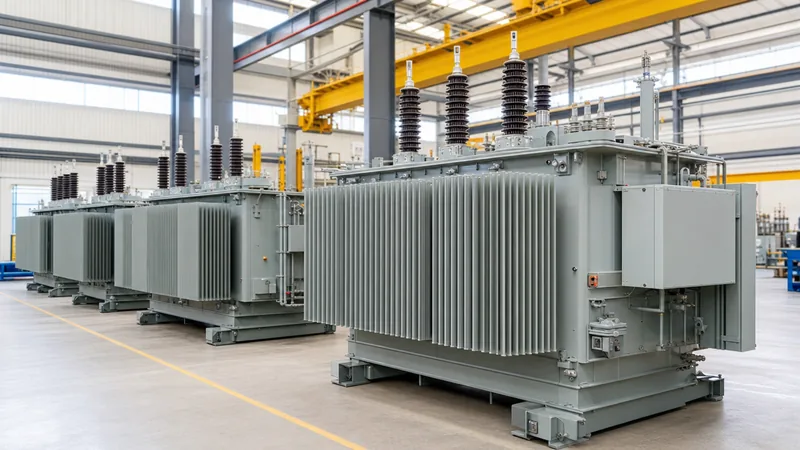
Mineral oil or ester fluid-filled transformers dominate outdoor plant switchyards and secondary substations due to superior heat dissipation, exceptional dielectric self-healing properties, and lower initial capital expenditure per kVA. However, liquid containment bunds, deluging fire suppression systems, and strict environmental setback distances are mandatory under NFPA 850 and local environmental regulations. In contrast, vacuum pressure impregnated (VPI) or cast resin dry-type transformers eliminate flammable liquids entirely, making them standard for indoor plant rooms, multi-storey buildings, and hazardous dust or chemical areas.
The following engineering comparison highlights critical operational parameters between the two technologies:
| Engineering Parameter | Oil-Immersed Distribution & Power | Cast Resin Dry-Type |
|---|---|---|
| Power Range Availability | 50 kVA up to 100+ MVA | 100 kVA up to 25 MVA |
| Dielectric Coolant | Mineral Oil, Synthetic/Natural Ester | Atmospheric Air (Class F or H resin) |
| Fire Risk & Flash Point | High (>140°C for oil; >300°C for ester) | Non-flammable, self-extinguishing |
| Installation Siting | Outdoor substations, dedicated vaults | Indoor switchrooms, plant basements |
| Winding Temp Rise Limit | 55°C to 65°C above ambient | 100°C to 125°C above ambient |
| Short-Circuit Mechanical Strength | High (dynamic hydraulic damping) | Extremely high (solid resin encasement) |
| Maintenance Regimen | Fluid DGA, acidity, breakdown testing | Periodic thermography and dust cleaning |
| Capital Cost per kVA | Lower baseline capital expenditure | 15% to 30% capital premium |
To examine continuous three-phase plant sizing and winding mechanics, refer to our comprehensive 3-phase transformer buyers guide.
Where to Buy Electrical Transformers: Procurement Channels and Factory Direct Sourcing
Knowing where to buy electrical transformers depends on whether your project demands off-the-shelf inventory for emergency replacement or bespoke engineering direct from the factory floor.
Industrial buyers typically choose between three primary supply channels:
- Direct Manufacturer Sourcing: Sourcing directly from an original equipment manufacturer provides complete control over technical specifications, tap-changer customisation, enclosure IP ratings (such as IP54 for dusty plant floors), and competitive pricing by bypassing intermediary markups. This route is optimal for medium- and large-scale industrial projects with planned 8- to 16-week lead times.
- Authorised Regional Distributors: Distributors stock standard utility ratings (e.g., 500 kVA to 2,500 kVA at standard voltages like 11 kV/415 V or 13.8 kV/480 V). This route suits emergency plant shutdowns where lead time outweighs customisation requirements, albeit at a higher unit cost.
- EPC Turnkey Integrators: Engineering, Procurement, and Construction contractors procure the transformer as part of a complete package alongside medium-voltage switchgear, cabling, and site civil works, taking single-point responsibility for system commissioning.
When procuring complex units, review our dedicated industrial power transformer selection guide to ensure your procurement team includes all essential utility interconnect clauses.
Step-by-Step Technical Procurement and Sizing Procedure
A disciplined, engineering-led procurement process prevents costly sizing errors, delivery delays, and premature operational failures.
- Calculate Maximum Continuous and Peak Demand: Establish total connected load in kilowatts (kW), applying realistic diversity and coincidence factors. Use the formula: S (kVA) = P (kW) / (Power Factor × Operating Efficiency), ensuring a minimum 20% to 25% margin for future plant expansion and motor inrush.
- Determine Network Fault Level and Impedance: Coordinate with the local electrical utility to obtain maximum prospective short-circuit MVA at the point of common coupling (PCC). Calculate the required transformer percentage impedance (%Z) to ensure downstream switchboards do not exceed their rated breaking capacity (e.g., 50 kA for 1 second).
- Establish Site Environmental Constraints: Document ambient temperature profiles (including maximum summer peaks above 40°C), altitude derating factors (IEC standards apply derating above 1,000 metres above sea level), seismic zone accelerations, and atmospheric pollution levels (such as marine salt fog or industrial chemical exposure).
- Compile Detailed Request for Quotation (RFQ) Data Sheets: Include mandatory winding material preferences (electrolytic copper versus electrical grade aluminium), cooling classifications, tapping steps, Marshalling box wiring, protection CT/PT integration, and digital temperature monitoring controllers.
- Witness and Validate Factory Acceptance Testing (FAT): Require documented routine test reports in compliance with IEC 60076-1, covering winding resistance measurement, voltage ratio verification, phase displacement checks, short-circuit impedance, no-load loss, and separate-source AC withstand tests.
Evaluating Losses, Standards Compliance, and Total Cost of Ownership
The true cost of an industrial transformer is dominated by electrical losses incurred over a typical 25- to 30-year design life rather than initial purchase price.
Transformer losses consist of two components: no-load (core) losses ($P_0$), which occur continuously whenever the unit is energised regardless of plant loading, and load (copper) losses ($P_k$), which vary quadratically with the operating load current. When evaluating tender proposals for industrial transformers for sale, engineers utilise Total Cost of Ownership (TCO) capitalisation formulas:
TCO = Purchase Price + (A × P_0) + (B × P_k)
In this equation, factor A represents the present capital value of continuous core losses (typically ranging from £3,000 to £8,000 per kilowatt depending on local commercial electricity tariffs and project lifecycle years), while factor B represents the capitalised value of load losses (typically £1,000 to £3,000 per kilowatt). Specifying high-grade, grain-oriented silicon steel (such as laser-scribed CRGO core laminations) reduces no-load losses significantly, ensuring compliance with strict regional efficiency mandates such as the European Ecodesign Directive (Tier 2 / EN 50588-1) or US Department of Energy (DOE 10 CFR Part 431) standards.
Verify that the manufacturer holds accredited ISO 9001, ISO 14001, and ISO 45001 certifications, alongside independent third-party type-test certificates proving short-circuit dynamic withstand capability.
Next steps: specifying and sourcing
To obtain an accurate technical proposal and competitive commercial tender for your project, prepare your single-line diagram (SLD), duty cycle specifications, and site environmental data sheets. Contact our technical sales engineering team directly through our transformer quotation page or submit your tender documents via our contact page. Browse our complete range of certified power transformers and rugged oil-immersed transformers to select the ideal platform engineered for your industrial facility.
Frequently asked questions
where to buy electrical transformers
You can buy electrical transformers directly from accredited manufacturers, specialised regional equipment distributors, or turnkey electrical EPC contractors. Sourcing directly from an established factory provides the greatest customisation, factory acceptance verification, and competitive pricing for commercial and industrial ratings.
What is the typical lead time when purchasing industrial transformers?
Standard distribution transformers up to 2,500 kVA typically carry factory lead times of 6 to 12 weeks, whereas custom medium-to-large power transformers require 12 to 24 weeks depending on raw material availability, core lamination grade, and factory production loading.
Should I choose copper or aluminium windings for an industrial transformer?
Both copper and aluminium meet all international electrical performance standards when properly engineered. Copper windings offer a more compact physical footprint and superior mechanical strength during fault conditions, whereas aluminium windings reduce total upfront capital cost for equivalent kVA ratings.
How do non-linear loads and harmonics affect transformer sizing?
Non-linear loads from variable-frequency drives and rectifiers generate harmonic currents that substantially increase eddy-current and stray losses, causing overheating. To prevent insulation degradation, you must specify a suitable K-factor rated transformer or derate a standard unit by 15% to 30%.
What core documentation should accompany an industrial transformer delivery?
Every unit must be dispatched with certified Factory Acceptance Test (FAT) reports, operation and maintenance manuals, general arrangement drawings, schematic wiring diagrams, certificate of origin, and warranty documentation confirming compliance with IEC 60076 or IEEE standards.
Tags: industrial transformers for sale industrial electrical transformers where to buy electrical transformers power transformers electrical procurement