Key takeaways
- A 3 phase high leg system provides 240V three-phase power for motor loads while delivering 120V single-phase power from a centre-tapped winding.
- The voltage from the high leg to neutral is mathematically 208V (nominal 207.85V), calculated as the line-to-neutral voltage multiplied by the square root of three.
- National Electrical Code (NEC) Article 110.15 mandates identifying the high leg with an orange finish or tagging, typically positioning it on Phase B of switchboards.
- Connecting 120V single-phase loads to the high leg will destroy appliances and controls rated for 120V due to the unexpected 208V potential to neutral.
- Open-delta transformer banks provide 57.7% of the capacity of a standard closed-delta bank and require distinct kVA sizing for the lighting and power pots.
Quick answer: A 3 phase high leg system (also known as a red-leg, wild-leg, or high leg delta) is a four-wire 120/240V delta secondary distribution configuration where one winding is centre-tapped to provide a neutral. This setup yields 240V three-phase between any two phase conductors, 120V single-phase from two of the phases to neutral, and approximately 208V from the third phase—the high leg—to neutral.
Historically deployed across light-industrial, agricultural, and commercial facilities with heavy three-phase motor loads alongside minor single-phase lighting requirements, the high leg configuration allowed electric utilities to serve diverse loads using a standard delta transformer bank without installing separate distribution services. However, handling this secondary arrangement demands strict adherence to engineering standards and identification protocols to avoid catastrophic equipment failure caused by inadvertent 208V line-to-neutral connections.
What Is a 3 Phase High Leg Delta Transformer System?
A high leg delta transformer secondary provides simultaneously 240V balanced three-phase power and 120V single-phase power from a single transformer bank. In a conventional three-phase wye system, line-to-neutral voltages are identical across all three phases, as discussed in our guide to 208V 3 phase power. In contrast, a 3 phase delta high leg arrangement uses a delta-connected secondary where only one phase winding (typically between phases A and C) has its centre point grounded to establish a system neutral conductor.
Because the neutral point is physically located at the midpoint of the winding between Phase A and Phase C, the voltage potentials are distributed as follows:
- Phase A to Phase B: 240V AC
- Phase B to Phase C: 240V AC
- Phase C to Phase A: 240V AC
- Phase A to Neutral: 120V AC
- Phase C to Neutral: 120V AC
- Phase B (the high leg) to Neutral: 208V AC
This configuration creates what field electricians refer to as a 120 240 delta service. The phases adjacent to the neutral tap (A and C) are referred to as the low legs, while the phase opposite the tap (Phase B) forms the high leg three phase conductor.
Mathematical Proof: Why a Delta Connection with High Leg to Ground Has 208V
The potential from the high leg to neutral equals 208V because it represents the altitude of an equilateral triangle formed by the 240V secondary delta winding vectors.
Consider a closed delta with three balanced voltage vectors of 240V forming an equilateral triangle on a phasor diagram. The centre tap on winding AC splits the 240V line into two equal 120V halves, $V_{AN} = 120\text{ V}$ and $V_{NC} = 120\text{ V}$, placed $180^\circ$ apart on the baseline. The high leg conductor connects to vertex B. To calculate the high leg voltage to ground ($V_{BN}$), we apply the Pythagorean theorem to the right-angled triangle formed by vertex B, neutral point N, and vertex A:
$$V_{AB}^2 = V_{AN}^2 + V_{BN}^2$$
$$240^2 = 120^2 + V_{BN}^2$$
$$57{,}600 = 14{,}400 + V_{BN}^2$$
$$V_{BN}^2 = 57{,}600 - 14{,}400 = 43{,}200$$
$$V_{BN} = \sqrt{43{,}200} = 120 \times \sqrt{3} \approx 207.85\text{ V}$$
Consequently, a delta connection with high leg to ground has a nominal voltage of 208V. This mathematical reality means that Phase B carries an unexpected potential above earth compared to typical 120V legs, presenting an insulation and overvoltage hazard if an engineer inadvertently routes control circuits or single-phase appliances between Phase B and neutral.
High Leg Delta Diagram, Code Rules, and Identification Requirements
National electrical standards mandate unequivocal physical identification for any high leg transformer termination to prevent inadvertent connection of 120V equipment to 208V.
Under NFPA 70 (National Electrical Code / NEC) Article 110.15, the high leg conductor must be durably identified at any point where a termination or splice is made if the neutral conductor is present. The identification must be finished with an orange outer finish, tagged with orange marking tape, or identified by an equally effective means. Furthermore, NEC Article 408.3(E) and 408.3(F) require that switchboards, switchgear, and panelboards supplied by a 4-wire delta-connected system have the high leg connected to Phase B (the centre busbar or centre terminal), unless metering equipment specifically requires Phase C placement (common in legacy revenue metering enclosures).
In a standard high leg delta diagram, three single-phase transformers or a three-phase unit transformer connect to primary distribution lines (often 13.8 kV or 4.16 kV). On the secondary side:
- Windings form a closed loop (A-B, B-C, C-A) or an open-V loop.
- A grounding electrode conductor connects to the midpoint of winding A-C.
- The neutral bus connects exclusively to this midpoint grounding terminal.
- Single-phase 120V breakers must only occupy Phase A and Phase C positions.
- Two-pole 240V breakers can tap A-C, A-B, or B-C.
- Three-pole breakers tap all three buses (A, B, C) for motor branch circuits, as detailed in our guide on 3 phase wiring motors diagrams.
120/240V High Leg Delta vs 120/208V and 277/480V Systems
Choosing between a 120/240V delta system, a 120/208V wye system, and a 277/480V wye system depends on the motor-to-lighting ratio and operational phase balancing requirements.
While 208V wye has largely replaced the high leg delta in modern commercial buildings, legacy plants and pump stations frequently retain the delta arrangement because 240V provides 15% more power per ampere of conductor than 208V for standard three-phase motors. Review our technical guide to 480V 3 phase power for industrial facilities exceeding 500 kVA.
| System Parameter | 120/240V High Leg Delta | 120/208V Wye (Y) | 277/480V Wye (Y) |
|---|---|---|---|
| Line-to-Line Voltage | 240 V | 208 V | 480 V |
| Line-to-Neutral (Phases A, C) | 120 V | 120 V | 277 V |
| Line-to-Neutral (Phase B) | 208 V (High Leg) | 120 V | 277 V |
| Motor Performance | Full 240V rated torque | Often requires de-rating 230V motors | Optimal for large motors >15 kW |
| 120V Circuit Availability | Only 2 of 3 phases available | All 3 phases available | Requires step-down transformer |
| Phase Balancing Complexity | High (risk of unbalance) | Low (symmetrical neutral) | Low (symmetrical neutral) |
| Utility Transformer Bank | 2 or 3 single-phase units | 3-phase wye or 3 units | 3-phase wye or 3 units |
| Primary Industrial Use | Agri-pumps, small machine shops | Commercial, office, retail | Manufacturing, process plants |
Open Delta vs Closed Delta: Sizing the High Leg Transformer Bank
Engineers can construct a 3 phase high leg bank using either three transformers in a closed delta or two transformers in an open delta (V-V) configuration.
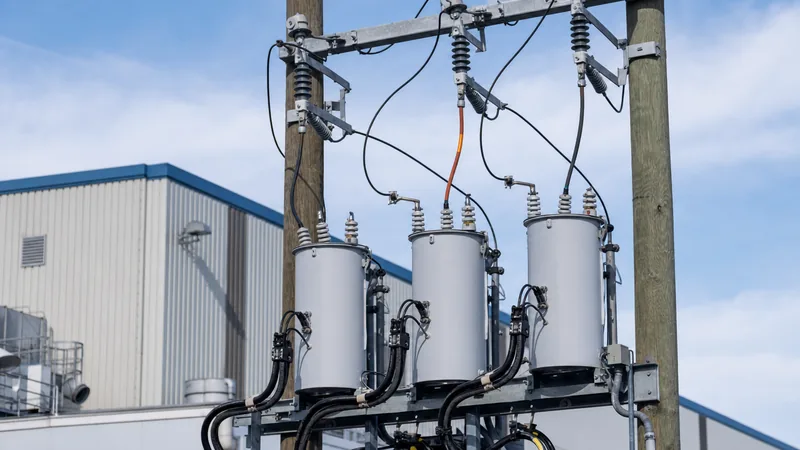
In an open-delta arrangement, often applied by utilities when initial motor loads are small, only two single-phase transformers are used. One unit serves as the "lighter" transformer (providing 120/240V single-phase lighting plus three-phase power), while the second unit serves as the "power" transformer (providing only three-phase power). The open-delta bank capacity is only 57.7% ($1 / \sqrt{3}$) of the combined nameplate rating of three equal units, or 86.6% of the sum of the two units.
For example, to calculate transformer sizing for a facility with a 45 kVA balanced three-phase motor load and a 20 kVA single-phase 120V lighting load:
- Determine the three-phase load contribution per transformer leg: $45\text{ kVA} / 3 = 15\text{ kVA}$.
- For a closed delta bank: The power transformers (B-C and A-B) each carry their 15 kVA three-phase share. The lighting transformer (A-C) must carry its 15 kVA three-phase share plus the entire 20 kVA single-phase lighting load, requiring a unit rated at least $15 + 20 = 35\text{ kVA}$ (standard selection: 37.5 kVA or 50 kVA unit). Learn more about transformer design in our single phase transformer guide.
- For an open-delta bank: The power unit must be sized for $45 / \sqrt{3} = 26\text{ kVA}$ (minimum 37.5 kVA unit), while the lighter unit must handle $26 + 20 = 46\text{ kVA}$ (minimum 50 kVA unit).
Field Testing and Commissioning Checklist for High Leg Systems
Commissioning a four-wire delta high leg switchgear panel demands systematic point-to-point voltage verification before energising any downstream branch circuits.
- Verify that the incoming high leg conductor is colour-coded with permanent orange tape or sleeving at the service head, pull boxes, and the main disconnect.
- Inspect the main distribution panelboard bus architecture to confirm that the orange high leg conductor lands squarely on Phase B (the centre bus).
- Measure and record secondary phase-to-phase voltages with a calibrated true-RMS multimeter: A-to-B must read 240V $\pm 5\%$, B-to-C must read 240V $\pm 5\%$, and C-to-A must read 240V $\pm 5\%$ according to IEEE C57.12.00 Table 5 tolerance bands.
- Measure and record phase-to-neutral voltages: A-to-N must read 120V $\pm 5\%$, C-to-N must read 120V $\pm 5\%$, and B-to-N must read 208V $\pm 5\%$.
- Confirm that no single-pole breakers or 120V single-phase branch circuits are physically connected or tabbed onto Phase B.
- Verify that all single-pole 120V lighting circuits are balanced evenly between Phase A and Phase C to avoid excessive neutral circulating currents and winding hotspot temperature rise.
Next steps: specifying and sourcing
When specifying replacement transformers or upgrading legacy 120/240V delta services, provide our engineering team with your primary distribution voltage (e.g. 11 kV, 13.8 kV, 34.5 kV), full secondary line voltage, expected single-phase lighting kVA, and total three-phase motor brake-power. Whether you require utility-grade pole-mounted transformers for overhead open-delta banks or high-efficiency oil-immersed transformers for industrial installations, our factory manufactures custom designs compliant with IEEE C57.12 and IEC 60076 standards. Contact our application engineering team via our quote page to review single-line diagrams, short-circuit impedance requirements, and tap configurations.
Frequently asked questions
What is a 3 phase high leg?
A 3 phase high leg is a four-wire 120/240V delta transformer connection with one centre-tapped grounded winding. This provides 240V across all three phases, 120V from two phases to neutral, and 208V from the third phase (the high leg) to neutral.
Why does a delta connection with high leg to ground have 208V?
The high leg measures 208V to ground because it represents the perpendicular vector distance from the centre tap of a 240V winding to the opposite delta vertex. Mathematically, this equals 120V multiplied by the square root of 3, resulting in 207.85V nominal.
Can you run 120V loads from the high leg?
No, you must never connect standard 120V loads to the high leg. Connecting a 120V device between the high leg and neutral supplies 208V, which quickly burns out power supplies, internal electronics, and motor windings.
What colour must the high leg be marked according to the NEC?
NEC Article 110.15 requires the high leg conductor to be identified with an orange outer finish or orange marking tape at any termination or splice point where the neutral conductor is present.
What is the difference between an open delta and closed delta high leg?
A closed delta high leg uses three single-phase transformers to deliver 100% bank rating, whereas an open delta uses two transformers operating in a V-connection. An open-delta bank provides only 57.7% of the capacity of a full three-transformer closed delta.
Which phase is the high leg placed on in a switchboard?
Under NEC Article 408.3(E), the high leg conductor must be connected to Phase B (the centre bus) inside panelboards, switchboards, and switchgear, unless utility revenue metering equipment requires Phase C connection.
Tags: 3 phase high leg high leg delta transformer 3 phase delta high leg high leg transformer 120 240 delta