Key takeaways
- SF6 gas possesses a dielectric strength approximately 2.5 times higher than dry air at atmospheric pressure and up to 100 times the arc-quenching capability.
- The compound name of SF6 is sulfur hexafluoride, an octahedral, non-polar inorganic compound with a molecular weight of 146.06 g/mol.
- Under IEC 62271-1 clause 6.3, the standard maximum relative leakage rate for sealed pressure systems is limited to 0.5% or 0.1% per annum.
- Electrical arcing breaks SF6 into toxic decomposition by-products including thionyl fluoride (SOF2), sulfuryl fluoride (SO2F2), and disulfur decafluoride (S2F10), demanding moisture controls below 15 ppmv.
- Modern grid design evaluates eco-friendly alternatives such as clean air and fluoronitrile gas mixtures to replace SF6 while managing equivalent dielectric clearances.
Quick answer: SF6 gas (sulfur hexafluoride) is a dense, non-toxic, synthetic inorganic gas renowned for its exceptional dielectric strength and thermal arc-interrupting performance. It serves as the primary insulating and arc-quenching medium inside medium-voltage (MV) and high-voltage (HV) electrical switchgear, circuit breakers, and gas-insulated substations (GIS) globally.
First synthesised in 1900 by Moissan and Lebeau, sf6 gas revolutionised power transmission and distribution equipment from the 1960s onward. Before its industrial adoption, switchgear engineers relied on atmospheric air, bulk mineral oil, or minimum-oil designs to interrupt fault currents. These legacy designs were physically massive, presented substantial fire hazards, and required intensive mechanical upkeep. The introduction of pressurized sulfur hexafluoride allowed high-voltage substations to compress footprints by up to 85% while delivering continuous operational reliability over decades.
Navigating the specification, containment, testing, and lifecycle stewardship of this medium requires a deep understanding of its chemical morphology, thermodynamics, and high-energy decomposition behaviour. Whether evaluating compact electrical switchgear systems or auditing substation integrity, electrical engineers must balance electrical performance with environmental containment protocols defined by international standards bodies.
What is SF6 Gas? Chemical Name, Structure, and Classification
The chemical name of SF6 is sulfur hexafluoride, which also represents the primary compound name of sf6 in IUPAC nomenclature. When engineers ask what is the name of sf6, it strictly denotes an inorganic, hypervalent molecule where a central sulfur atom bonds with six peripheral fluorine atoms in an octahedral coordination geometry (Oh symmetry group). Answering what is sf6 fundamentally begins with its unique chemical bonding: the covalent bonds between sulfur and the highly electronegative fluorine atoms exhibit short bond lengths (156.4 pm) and exceptionally high bond dissociation energies (approximately 390 kJ/mol per bond).
Regarding its sf6 type of compound classification, sulfur hexafluoride is an inorganic, non-flammable, non-polar covalent gas. At ambient temperature (20 °C) and standard atmospheric pressure (101.325 kPa), pure sulfur hexafluoride sf6 is completely colourless, odourless, tasteless, and chemically inert. Because all valence electrons of the sulfur atom are engaged in stable sp3d2 hybridised sigma bonds, the gas exhibits near-noble chemical stability, resisting reaction with water, concentrated acids, and strong alkalis at temperatures below 500 °C.
With a molecular weight of 146.06 g/mol, the density of gaseous SF6 is approximately 6.13 kg/m³ at standard temperature and pressure—making it roughly five times heavier than dry atmospheric air (1.20 kg/m³). This high density influences its physical handling: in unventilated substations, any fugitive gas release settles in basement trenches, cable ducts, and lower containment vessels, presenting potential asphyxiation risks despite its non-toxic classification in pristine form.
Dielectric and Thermal SF6 Gas Properties
The superior operational value of sf6 gas properties stems from a combination of strong electronegativity, high density, and anomalous thermal conductivity within the arcing temperature envelope. The primary dielectric mechanisms and physical constants are detailed below:
- Electronegativity and Electron Capture: Fluorine atoms possess the highest Pauling electronegativity (3.98). When a high-voltage flashover initiates, free electrons in the gap are captured by neutral SF6 molecules to form heavy, stable negative ions (such as SF6⁻, SF5⁻, and F⁻). Because these massive ions exhibit low mobility compared to free electrons, electron avalanche propagation is curtailed, preventing dielectric breakdown across contact clearances.
- Dielectric Withstand Voltage: At atmospheric pressure, the breakdown voltage of SF6 is approximately 2.5 to 3 times that of air. When pressurized to 0.4–0.6 MPa (absolute) in typical switchgear tanks, its dielectric withstand matches or exceeds that of high-grade transformer mineral oil.
- Thermal Arc Quenching: Between 1,500 K and 2,500 K—the critical temperature zone for plasma recombination during AC current zero—the thermal conductivity of sulfur hexafluoride exhibits a sharp peak due to molecular dissociation and recombining kinetics. This thermal absorption cools the arc core rapidly, accelerating post-arc gap recovery.
- Dielectric Recovery Rate: Following current zero in an alternating current waveform, the dielectric strength recovers up to 100 times faster than air, allowing minimal arc duration during short-circuit clearing.
The following engineering data table compares the foundational physical parameters of SF6 against conventional dielectric media under standard conditions:
| Property / Parameter | Unit of Measure | SF6 Gas | Dry Atmospheric Air | Mineral Insulating Oil |
|---|---|---|---|---|
| Molecular Weight | g/mol | 146.06 | 28.96 | ~300 to 450 |
| Gas Density (101.3 kPa, 20 °C) | kg/m³ | 6.13 | 1.20 | 870 to 890 (liquid) |
| Relative Dielectric Strength (Air = 1.0) | — | 2.5 – 3.0 | 1.0 | 3.5 – 4.0 |
| Thermal Conductivity (at 300 K) | W/(m·K) | 0.013 | 0.026 | 0.126 |
| Critical Temperature | °C | 45.55 | -140.6 | N/A (Boiling > 300) |
| Critical Pressure | MPa (abs) | 3.76 | 3.77 | N/A |
| Global Warming Potential (GWP, 100-yr) | CO2-equivalent | 23,500 to 25,200 | 0 | N/A (< 1) |
| Atmospheric Lifetime | Years | 3,200 | N/A | N/A |
Primary SF6 Uses Across Power Transmission and Distribution
Industrial sf6 uses span several engineering disciplines, but medium- and high-voltage power networks account for over 80% of global consumption. Within substations, sulfur hexafluoride operates as both an internal dielectric insulation blanket and an active arc-interruption medium.
Key applications within modern electrical power infrastructure include:
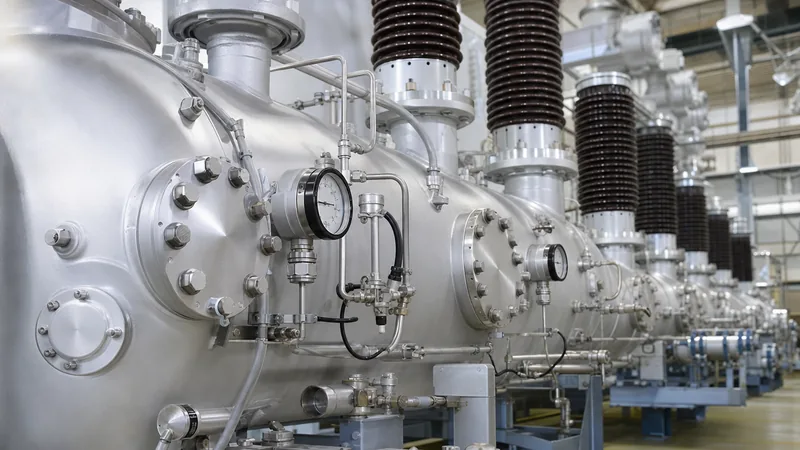
- Gas-Insulated Switchgear (GIS): Enclosed aluminium tanks housing circuit breakers, disconnectors, earthing switches, and instrument transformers submerged in SF6 at 0.35 to 0.7 MPa. GIS installations require only 10% to 15% of the real estate consumed by conventional air-insulated substations (AIS), making them vital for urban nodes, offshore wind platforms, and industrial manufacturing plants.
- Gas-Insulated Lines (GIL): High-capacity transmission corridors running underground or through tunnels, carrying continuous currents above 3,000 A at 145 kV to 800 kV with minimal electromagnetic field emissions.
- Medium-Voltage Ring Main Units (RMU): Compact, sealed distribution switchboards operating between 11 kV and 36 kV. Sealed-for-life stainless steel tanks eliminate environmental ingress, such as dust, humidity, and salt spray. For comparative architecture between RMU and conventional switchgear, explore our analysis of ring main units vs metal-clad switchgear.
- High-Voltage Circuit Breakers: Independent live-tank or dead-tank interrupters designed to clear fault currents from 25 kA up to 63 kA at system voltages ranging from 72.5 kV to 1,200 kV.
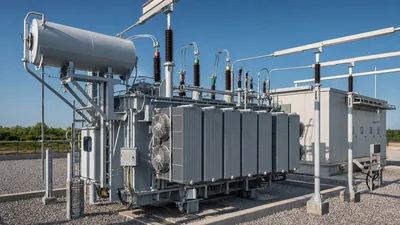
- Gas-Insulated Transformers (GIT): Non-flammable power transformers where SF6 replaces mineral oil for fire-critical indoor or underground substations. Siting considerations for these substations align with protocols outlined in our substation transformer guide.
Operating Mechanics of the SF6 Breaker and Arc Quenching
An sf6 breaker relies on the rapid cooling and electron-capturing capability of sulfur hexafluoride to extinguish high-power alternating current arcs at natural current zero. When fault currents occur, the trip coil triggers an energy storage mechanism (typically spring-hydraulic or pure spring-driven), pulling the moving contact assembly away from the stationary contact inside an interrupter chamber.
Over the evolution of high-voltage interruption, two primary mechanical arc-extinction designs have defined the modern sf6 gas circuit breaker:
- Puffer-Type Interrupters (Single Pressure): As the moving contact assembly retracts, an attached cylinder compresses trapped SF6 gas against a stationary piston. The mechanical compression forces a high-velocity blast of cool gas through an insulating PTFE nozzle directly across the plasma arc column. This longitudinal blast extracts thermal energy from the arc until it collapses at current zero. Puffer designs require substantial operating mechanism energy to compress the gas during opening.
- Self-Blast (Thermal Autopuffer) Interrupters: Modern sf6 breakers employ the thermal energy of the electric arc itself to generate quenching pressure. The intense heat of the arc increases pressure inside an expansion volume. As the current approaches zero, the hot, over-pressurised gas vents back into the arc core through an aerodynamic nozzle, extinguishing the arc. A small mechanical puffer assists during low-current switching where arc heating is insufficient. This hybrid self-blast topology slashes mechanism energy requirements by up to 50%, prolonging mechanical operating endurance to class M2 (10,000 operations per IEC 62271-100 clause 6.102).
During interruption, arc temperatures reach 15,000 K to 20,000 K, temporarily dissociating SF6 into atomic sulfur, fluorine, and lower fluorides. As the plasma stream cools below 1,500 K, these dissociated species recombine into stable SF6. Provided moisture and contaminant levels remain controlled, recombination efficiency exceeds 99%, preserving the chamber's dielectric integrity across repeated operations.
Gas Quality, Moisture Limits, and Testing Standards
IEC 60376 and IEC 60480 govern the technical purity and re-use limits of sulfur hexafluoride in electrical equipment. Virgin gas supplied to switchgear tanks must meet strict purity thresholds to prevent premature breakdown or internal chemical degradation.
Water vapour poses the greatest hazard to gas-filled switchgear. When arc discharges interact with moisture (H2O), the recombination pathway is compromised, producing highly corrosive and toxic acidic by-products according to the following reaction pathways:
SF4 + H2O → SOF2 + 2 HFSOF2 + H2O → SO2 + 2 HF
Hydrofluoric acid (HF) etches glass, glazed ceramic insulators, and moisture-absorbing molecular sieves, creating conductive fluoride deposits across insulating barriers. Thionyl fluoride (SOF2) and sulfuryl fluoride (SO2F2) are volatile, toxic gases that irritate respiratory systems. To prevent internal condensation and acid formation, IEC 62271-1 clause 6.3 establishes strict moisture thresholds.
The engineering limits for gas quality in operating circuit breakers are summarised below:
- SF6 Purity: Greater than or equal to 97.0% by volume (per IEC 60480 for recycled/in-service gas) and ≥ 99.7% for new gas (IEC 60376 Table 1).
- Moisture Content (Circuit Breakers): Dew point must not exceed -36 °C at atmospheric pressure (equivalent to < 150 ppmv at 20 °C) in gas-insulated circuit breakers. For disconnectors and busbars without active arcing, the upper limit is -23 °C (< 300 ppmv).
- Acidity (calculated as HF equivalent): Maximum allowable limit is 1.0 ppmw per IEC 60480.
- Decomposition Products (SO2 + SOF2): In-service threshold must remain below 12 ppmv. Readings above 50 ppmv indicate severe internal contact erosion, partial discharge, or desiccant saturation.
- Desiccant Management: Switchgear tanks incorporate internal molecular sieve packets (synthetic zeolites type 13X or 4A) sized to absorb both trace moisture and arcing by-products over the equipment's 30- to 40-year design life.
Gas Leakage Rate Calculations and Mass Monitoring
IEC 62271-1 defines acceptable gas leakage rates for closed and sealed pressure systems, ensuring pressure stability between maintenance overhauls. For high-voltage switchgear, the standard specifies a maximum permissible relative leakage rate (Frel) of no more than 0.5% per annum, with precision designs achieving less than 0.1% per annum.
Monitoring gas inventory relies on absolute density rather than raw gauge pressure, as pressure fluctuates with ambient and operational temperature changes. Switchgear enclosures utilise temperature-compensated pressure switches (density monitors) calibrated to a constant isochore.
To evaluate inventory containment, consider a worked engineering calculation for an outdoor 145 kV gas-insulated circuit breaker pole unit:
Given Parameters:
- Internal chamber free volume ($V$): 0.85 m³
- Rated filling pressure at 20 °C (293.15 K) absolute ($P_1$): 0.60 MPa (600 kPa)
- Universal gas constant ($R$): 8.314 J/(mol·K)
- Molar mass of SF6 ($M$): 0.14606 kg/mol
- Compressibility factor ($Z$) for SF6 at 0.6 MPa abs and 20 °C: 0.942
- Maximum allowable leakage rate per IEC 62271-1: 0.5% per annum
Step 1: Calculate the total mass ($m$) of SF6 gas installed:
Using the real gas equation of state: $P \cdot V = Z \cdot n \cdot R \cdot T = Z \cdot \left(\frac{m}{M}\right) \cdot R \cdot T$
m = (P × V × M) / (Z × R × T)
m = (600,000 Pa × 0.85 m³ × 0.14606 kg/mol) / (0.942 × 8.314 J/(mol·K) × 293.15 K)
m = 74,490.6 / 2,295.88 = 32.44 kg of SF6 per phase
Step 2: Determine maximum permissible annual mass loss ($\Delta m_{annual}$):
Δm_annual = m × 0.005 = 32.44 kg × 0.005 = 0.1622 kg/year (162.2 g/year)
Step 3: Calculate the maximum allowable daily leak rate during factory sealing tests:
Daily limit = 162.2 g / 365 days = 0.444 g/day
During factory acceptance testing (FAT), sniff testing using photoacoustic spectroscopy or helium mass spectrometry validates that individual seal interfaces (flanges, cast-resin bushings, and rupture discs) do not exceed this leakage threshold.
Environmental Regulations and Eco-Friendly Switchgear Alternatives
Despite its outstanding dielectric reliability, sf6 gas is subject to stringent global environmental scrutiny due to its atmospheric persistence and heat-trapping capacity. The Intergovernmental Panel on Climate Change (IPCC) assigns sulfur hexafluoride a Global Warming Potential (GWP) of approximately 24,300 over a 100-year time horizon. Furthermore, its chemical bond stability results in an estimated atmospheric lifetime of 3,200 years.
International frameworks, including the European Union F-gas Regulation (EU 2024/573), mandate progressive phase-outs of new SF6 installations: medium-voltage equipment up to 24 kV faces restrictions by 2026, extending to 145 kV by 2032. Substation operators are implementing advanced asset management frameworks, automated mass-balance accounting, and closed-loop gas recovery carts per IEC 62271-4.
To transition beyond sulfur hexafluoride, equipment manufacturers have developed two primary technical pathways:
- Vacuum Interruption in Clean Air (Synthetic Air / Technical Air): Vacuum interrupter bottles clear the arc, while technical air (a dehydrated blend of 80% N2 and 20% O2 at -50 °C dew point) provides passive enclosure insulation. Widely implemented from 12 kV up to 72.5 kV, this design features zero GWP, zero toxic decomposition products, and straightforward site gas management.
- Fluoronitrile-Based Gas Mixtures (Fluoronitrile / CO2 / O2): For high-voltage applications up to 420 kV, blends of fluoronitrile gas diluted with carbon dioxide and oxygen deliver dielectric ratings equivalent to SF6. These gas mixtures reduce the overall global warming footprint by 95% to 99% while operating within standard GIS tank profiles down to -25 °C without gas liquefaction.
Site Receiving and Maintenance Checklist for SF6 Switchgear
Field commissioning and maintenance engineers must execute systematic verification protocols before energising gas-insulated apparatus. Inadequate filling, contaminated hoses, or distorted seal faces lead directly to uncontained flashovers or gas escape.
Engineers should execute the following inspection protocol before hand-over:
- Visual Inspection of Transport Gauges: Inspect external shipping pressure gauges. Switchgear shipped under positive transport pressure (typically 0.02 to 0.05 MPa gauge dry N2 or SF6) must show positive reading. Zero or negative pressure indicates shipping transit damage to rupture discs or casing seals.
- Evacuation and Vacuum Holding Test: When filling on site, evacuate the chamber using a certified vacuum recovery cart down to ≤ 100 Pa (1 mbar). Isolate the pump and hold vacuum for 30 minutes. An upward pressure creep indicates an ambient seal leak or moisture boil-off.
- Controlled Gas Filling: Charge virgin or recycled gas through stainless-steel-braided PTFE hoses equipped with self-sealing dry-break couplings. Regulate the filling flow to prevent rapid adiabatic chilling, which can damage internal polymer supports. Fill to rated filling density ($P_r$) corrected to current chamber temperature.
- Moisture and Purity Verification: Allow gas to stabilize for 24 hours post-filling. Sample gas using an electrochemical sensor or photoacoustic multi-gas analyzer. Confirm SF6 concentration ≥ 99.0% and dew point ≤ -36 °C per IEC 60480.
- Sniff Leak Testing: Scan all bolted flange interfaces, pressure relief valves, and density monitors using an infrared camera (optical gas imaging tuned to 10.55 μm) or an electronic halogen leak detector with a sensitivity threshold ≥ 1 × 10⁻⁶ mbar·l/s.
- Density Switch Calibration Check: Electrically verify the alarm and lockout thresholds on the temperature-compensated density monitor against the manufacturer's nominal trip table. Test that lockout contacts prevent trip or close operation when pressure drops below $P_{min}$.
Integrating these testing routines alongside comprehensive transformer protection systems guarantees that modern switchgear and substations maintain uninterrupted network stability.
Next steps: specifying and sourcing
When preparing specifications for high-voltage and medium-voltage switchgear, clarity regarding internal dielectric media, temperature ratings, and leak thresholds is critical to project procurement. Specify the enclosure filling pressure, target operating ambient range (-40 °C to +40 °C), and compliance with IEC 62271-1, IEC 62271-100, and IEC 62271-200. Detail the maximum permissible leakage rate (≤ 0.1% per year), density monitor alarm/lockout trip contacts, and gas sampling port configurations. Review our engineered HV/LV switchgear solutions and modular prefabricated transformer substations. For project technical reviews or commercial quotations, submit single-line diagrams directly to our engineering desk via our switchgear quotation portal.
Frequently asked questions
what is sf6
SF6 (sulfur hexafluoride) is an inorganic, non-toxic, synthetic gas used as an electrical insulator and arc-extinguishing medium in medium- and high-voltage switchgear. It features an octahedral molecular structure that provides roughly 2.5 times the dielectric withstand voltage of air and rapid thermal arc-quenching capability.
what is the name of sf6
The formal chemical and IUPAC name of SF6 is sulfur hexafluoride. It consists of one central sulfur atom covalently bonded to six surrounding fluorine atoms, forming a dense, hypervalent, non-polar compound with the molecular formula SF6.
Why is SF6 used in circuit breakers instead of air?
SF6 provides a dielectric strength up to three times higher than air at identical pressure and recovers its insulating properties 100 times faster after an electric arc. This allows switchgear engineers to clear severe fault currents across compact contact gaps, reducing switchboard footprints and maintenance frequency.
Is SF6 gas dangerous to humans?
Pure SF6 gas is non-toxic, non-flammable, and chemically inert, but it acts as a simple asphyxiant because it is five times heavier than air and displaces oxygen in confined spaces. In service, arcing can create hazardous decomposition by-products, including sulfuryl fluoride, thionyl fluoride, and toxic hydrofluoric acid, requiring specialised handling.
What happens to SF6 gas during a short-circuit fault?
Under high-temperature arc plasma (up to 20,000 K), SF6 dissociates into sulfur, fluorine, and lower fluoride ions to cool and extinguish the arc. Once the current clears and temperature drops below 1,500 K, over 99% of these fragmented ions recombine into SF6, with remaining trace radicals captured by internal molecular sieve desiccants.
How do you detect an SF6 gas leak in operating switchgear?
Engineers identify SF6 leaks using optical gas imaging (OGI) infrared cameras tuned to the 10.55-micrometre absorption band, portable halogen leak detectors, or photoacoustic spectroscopy. Continuous system monitoring is managed via temperature-compensated density monitors that signal alarm contacts when absolute pressure falls below design thresholds.
Tags: sf6 gas sf6 breaker sf6 gas circuit breaker sulfur hexafluoride sf6 sf6 gas properties