Key takeaways
- Outdoor electrical terminations require a minimum ingress rating of IP66 per IEC 60529 or NEMA 4X to prevent moisture ingress driven by cyclic solar thermal pumping.
- Grade 316 stainless steel or glass-reinforced polyester (GRP) prevents galvanic and pitting corrosion in saline or high-humidity substation environments.
- Solar irradiation adds up to 500 W/m² of thermal loading to external enclosures, necessitating calculated derating or integrated ventilation breathers.
- Underground deployment demands continuous submersion-rated enclosures compliant with IP68 (IEC 60529 Table 2) or resin potting to prevent hydrolytic insulation breakdown.
- Factory acceptance protocols must verify torque-retention standards, gasket compression set, and earthing continuity below 0.1 ohms across all metallic interfaces.
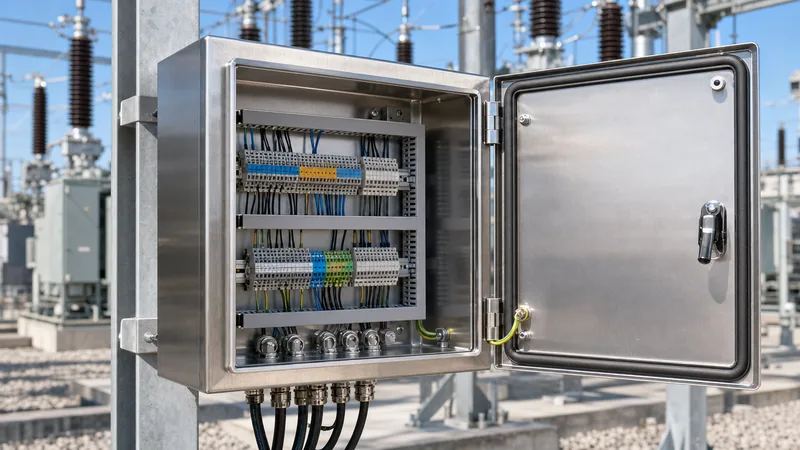
Quick answer: A terminal box outdoor is an ingress-protected enclosure designed to terminate, marshal, and protect low-voltage power, control, and instrumentation cabling in exposed environmental conditions. Typical industrial installations require an ingress protection rating of IP66 or NEMA 4X to safeguard connections from torrential rain, dust, and solar UV degradation.
In high-reliability power systems, such as pad-mounted switchgear yards and prefabricated secondary substations, the boundary between field wiring and control electronics represents a common point of operational vulnerability. Outdoor marshaling and junction units undergo extreme thermal cycles, diurnal pressure differentials, and continuous exposure to moisture. Selecting an appropriately specified outdoor low voltage box ensures that control signals, auxiliary power feeds, and current transformer (CT) secondary loops remain physically intact and electrically isolated from harsh ambient surroundings.
Whether terminating auxiliary circuits adjacent to a unit substation installation or housing instrument taps within a power distribution yard, balance-of-plant engineers must weigh enclosure materials, gasket durability, cable glanding topologies, and condensation control methods. This guide details practical specification criteria, installation parameters, and thermal calculations for deploying reliable outdoor marshaling nodes.
IP and NEMA Ratings for a Terminal Box Outdoor
A terminal box outdoor must withstand driven rain, blowing sand, and solar-induced negative pressure transitions without allowing moisture migration into the wiring compartment.
Ingress protection for an electrical enclosure is defined internationally by IEC 60529 and in North America by NEMA 250. For an above-ground low voltage junction box outdoor, an IP rating of IP65 is often considered the bare minimum, but it remains susceptible to water intake under severe driving rain or pressure washing. Factory specifications for critical utility infrastructure consistently mandate IP66 or NEMA 4X as the engineering baseline.
| Standard Rating | Dust Protection | Liquid Protection Metric | Substation & Industrial Application |
|---|---|---|---|
| IP65 (IEC 60529) | Dust-tight (talcum vacuum test) | Water projected in jets (6.3 mm nozzle, 12.5 L/min at 30 kPa) | Sheltered outdoor or canopy-covered areas |
| IP66 (IEC 60529) | Dust-tight | Water projected in powerful jets (12.5 mm nozzle, 100 L/min at 100 kPa) | Exposed substation yard marshaling, coastal sites |
| IP67 (IEC 60529) | Dust-tight | Immersion up to 1 m depth for 30 minutes | Temporary flood-prone drainage pits, trenches |
| IP68 (IEC 60529) | Dust-tight | Continuous submersion under specified head (e.g., 3 m for 72 h) | Direct burial, manholes, submerged cable ducts |
| NEMA 4X (NEMA 250) | Windblown dust and rain | Hose-down test (65 gpm), plus 200 h salt-spray corrosion resistance | Aggressive chemical, coastal, and offshore environments |
To understand the mechanics of enclosure selection, engineers must account for the thermal pumping phenomenon. When direct sunlight warms an unvented covered electrical box, internal air expands and vents through microscopic imperfections in gaskets. As evening arrives and the enclosure cools rapidly, a partial vacuum develops internally, drawing in humid ambient air. Without proper pressure compensation breathers, this moisture condenses on terminal strips, initiating tracking faults and copper corrosion. For deeper enclosure mechanical design rules, review the electrical enclosures engineering guide.
Material Selection: 316 Stainless Steel, GRP, and Coated Steel
Choosing the correct structural material dictates the design life of an outdoor enclosure against mechanical impact, ultraviolet degradation, and atmospheric corrosion.
Material failure in the field rarely stems from structural collapse; it manifests as pit corrosion through wall sections, hinge seizure, or UV embrittlement of polymer latches. When specifying equipment under IEC 61439 design verification standards, enclosure performance must align with the site atmospheric corrosivity category (ISO 9223 C1 to severe marine environments).
- Grade 316L Stainless Steel: Containing 2% to 3% molybdenum, 316L provides superior resistance to chloride pitting compared to standard 304 steel. It is the premier selection for coastal substations, chemical processing yards, and offshore platforms. A minimum sheet thickness of 1.5 mm to 2.0 mm prevents warping during fabrication and ensures structural rigidity under wind loading.
- Glass-Reinforced Polyester (GRP / FRP): Offering complete immunity to electrochemical corrosion, GRP is non-conductive, mitigating touch-potential hazards in public or unbonded distribution areas. Modern compounds include UV stabilisers to prevent fiber blooming under high solar exposure. However, GRP exhibits lower impact ratings (typically IK08 per IEC 62262) relative to stainless steel (IK10).
- Powder-Coated Galvanised Mild Steel: Economical for inland industrial sites (ISO 9223 C3 environments). Pre-galvanised sheet (minimum 275 g/m² zinc coating) treated with a polyester powder coat (minimum 80 to 120 microns dry film thickness) offers durable outdoor performance, provided the coating is not chipped or mechanically scratched during installation.
- Cast Aluminium Alloy (AlSi12): Frequently deployed for explosion-proof terminal boxes or heavy-duty junction points. Cast enclosures offer exceptional rigidity and electromagnetic shielding, though they require anodising or epoxy treatments when deployed in marine environments to avert galvanic degradation.
Cable Entry, Glanding, and Internal Arrangement
Cable entry points represent the primary failure interface for field ingress, requiring strict adherence to glanding practices and internal clearance geometry.
A well-engineered outdoor low voltage box must maintain adequate physical separation between power conductors and sensitive instrumentation. When marshaling cables enter an enclosure from below, the bottom gland plate should be constructed from unpainted brass, stainless steel, or non-ferromagnetic aluminium to prevent eddy current heating during high-current phase imbalance.
- Gland Selection: Install dual-seal, compression-type brass or 316 stainless steel cable glands rated for high ingress protection. For armoured cables (SWA or braided), the gland must clamp both the inner sheath and armour wires, establishing a 360-degree mechanical earth bond with low earth fault impedance per BS 6121 / EN 62444.
- Drip Loops: Always configure incoming and outgoing field cables with an external downward drip loop prior to the gland entry. This physical curve sheds running surface rainwater before the moisture reaches the gland threads.
- DIN Rail Topography: Mount DIN rails on standoffs elevated at least 25 mm off the backplate. Maintain a minimum clearance of 100 mm between terminal blocks and horizontal wireways to permit adequate bending radius for stiff copper conductors (such as 4 mm² to 16 mm² stranded multi-core control cables).
- Internal Segregation: Separate 400 V auxiliary three-phase power lines from 24 V DC control or 4-20 mA analogue signals using an insulated partitioning barrier, avoiding electromagnetic interference in signal loops.
Watertight Underground Junction Box vs Above-Ground Marshaling
Subsurface cable joints require continuous submersion ratings and chemical barrier technologies that exceed standard above-ground enclosure specifications.
When trenching routing or site aesthetics preclude above-ground kiosks, a waterproof underground electrical junction box or pit-mounted enclosure becomes mandatory. However, underground utility chambers frequently fill with subterranean groundwater, surface runoff, and hydrocarbon residues, exposing electrical terminations to continuous hydrostatic head pressure.
While an above-ground terminal box outdoor manages shedding rain via pitched roof hoods and elastomeric gaskets, a watertight underground junction box must meet IEC 60529 IP68 parameters, routinely tested at 1 to 5 metres of water depth for durations exceeding 72 hours. Standard compression gaskets are generally insufficient for subterranean longevity; installations rely on two-part re-enterable polyurethane or silicone resin potting compounds. The resin completely encapsulates bare conductors, terminal studs, and crimp splices, displacing all air voids and preventing moisture ingress even if the outer enclosure casing sustains physical impact or seal degradation.
Thermal Dissipation and Condensation Management Calculation
Thermal analysis of an outdoor junction enclosure ensures that internal temperatures remain within component operating limits while mitigating condensation risks.
Internal heat generation ($P_{int}$) arises from conductor resistance ($I^2R$ losses) across terminal blocks and contact resistances. Simultaneously, solar irradiation ($P_{sun}$) strikes the exterior surface, while the enclosure dissipates heat via natural convection and radiation ($P_{diss}$) through its metallic walls.
Consider an unventilated 316 stainless steel marshaling box with dimensions of 800 mm (height) × 600 mm (width) × 300 mm (depth), installed in an ambient environment of 40 °C with peak horizontal solar irradiation of 800 W/m².
- Step 1: Calculate Effective Surface Area ($A_e$): Per IEC TR 60890, for a wall-mounted enclosure with exposed front, sides, top, and base:
Total exposed area $A = (0.8 \times 0.6) + 2(0.8 \times 0.3) + 2(0.6 \times 0.3) = 0.48 + 0.48 + 0.36 = 1.32\text{ m}^2$. - Step 2: Calculate Internal Heat Load ($P_{int}$): The box houses 40 terminal connections carrying 15 A each. Terminal contact resistance is 1.2 mΩ per connection point.
$P_{int} = 40 \times (15\text{ A})^2 \times 0.0012\text{ }\Omega = 40 \times 225 \times 0.0012 = 10.8\text{ W}$. - Step 3: Solar Radiation Heat Absorption ($P_{sun}$): Painted or polished stainless steel has an absorption coefficient ($\alpha$) of approximately 0.45. With effective projected top and front solar area $A_{proj} \approx 0.48 + (0.6 \times 0.3) = 0.66\text{ m}^2$:
$P_{sun} = A_{proj} \times \alpha \times \text{Irradiance} = 0.66\text{ m}^2 \times 0.45 \times 800\text{ W/m}^2 = 237.6\text{ W}$. - Step 4: Total Thermal Load and Steady-State Temperature Rise ($\Delta T$): Total thermal input $P_{tot} = P_{int} + P_{sun} = 10.8\text{ W} + 237.6\text{ W} = 248.4\text{ W}$.
Heat transfer coefficient for natural outdoor convection ($k$) is roughly 5.5 W/(m²·K).
$\Delta T = \frac{P_{tot}}{k \times A_e} = \frac{248.4}{5.5 \times 1.32} = \frac{248.4}{7.26} \approx 34.2\text{ K}$.
Internal operating temperature $T_{int} = T_{amb} + \Delta T = 40\text{ }^\circ\text{C} + 34.2\text{ }^\circ\text{C} = 74.2\text{ }^\circ\text{C}$.
Because an internal temperature of 74.2 °C approaches the thermal degradation threshold of standard PVC insulation and solid-state relays, the engineer must either specify an external sunshield (slashing absorbed solar gain by up to 70%) or increase enclosure envelope dimensions. Additionally, to combat night-time condensation when internal relative humidity reaches dew point, install an anti-condensation heater rated between 30 W and 50 W, controlled by an integrated hygrostat set to 65% relative humidity.
Factory Acceptance Testing and Inspection Checklist
A structured quality control and inspection protocol verifies enclosure mechanical integrity and sealing compliance before site installation.
Procurement teams must ensure that vendor documentation aligns with standard test sequences. Utilize the following factory checklist when evaluating sample units or witness testing complete assemblies:
- Dimensional and Material Verification: Confirm base sheet metal thickness via ultrasonic gauge (tolerance per ISO 2768-m). Verify mill test certificates for material composition (Grade 304 vs 316L chemical makeup per ASTM A240).
- Gasket Adhesion and Compression Set: Inspect foamed-in-place polyurethane (FIPG) or EPDM neoprene continuous gaskets. Ensure seamless corners without manual joints. Measure compression set per ISO 815; gasket rebound must exceed 85% after 24 hours under 50% deflection.
- Earth Continuity Test: Measure resistance between the door, enclosure body, internal chassis plate, and external earthing stud using a calibrated 25 A micro-ohmmeter. The reading must not exceed 0.1 Ω per IEC 61439-1 Clause 10.5.2.
- IP Ingress Testing: Review third-party laboratory test reports for IP66 compliance (IEC 60529 water jet test with a 12.5 mm nozzle at 100 kPa for 3 minutes). Confirm that no moisture penetrated the interior space.
- Paint Dry Film Thickness (DFT): For powder-coated enclosures, use an electromagnetic coating thickness gauge per ISO 2808 across 10 distinct points, verifying an average coating thickness between 80 µm and 120 µm.
Next steps: specifying and sourcing
When preparing an inquiry for a project-specific terminal box outdoor, engineering teams should compile a comprehensive datasheet detailing environmental extremes, system operational voltages, required cable gland cutouts, and ingress ratings. Clarify whether your design requires integrated anti-condensation heaters, solar radiation shields, or pre-wired marshaling strips. Explore our industrial distribution platforms, including secondary transformer substations and high-durability HV/LV switchgear solutions, built to international IEC and IEEE specifications. To receive technical drawings, material test certifications, or a comprehensive project estimate, submit your bill of materials through our technical team at request a project quote.
Frequently asked questions
What is the recommended IP rating for a terminal box outdoor?
An ingress protection rating of IP66 per IEC 60529 is the standard recommendation for outdoor terminal boxes. This ensures protection against windblown dust and high-pressure water jets from heavy storms. For temporary or permanent water immersion, ratings of IP67 or IP68 are required.
How do you prevent condensation inside an outdoor electrical box?
Condensation is prevented by installing a thermostatically or hygrostat-controlled anti-condensation space heater alongside semi-permeable ePTFE pressure compensation breathers. The heater keeps the internal air temperature above the ambient dew point, while the breather equalises internal pressure differentials without compromising ingress protection.
Can I use standard mild steel for an outdoor junction box?
Standard mild steel must not be used outdoors without hot-dip galvanising and a high-durability polyester powder-coat finish. In coastal, marine, or heavily polluted industrial environments, grade 316 stainless steel or glass-reinforced polyester (GRP) should be specified to prevent premature corrosion.
What is the difference between IP67 and IP68 underground junction boxes?
An IP67 enclosure withstands temporary immersion in water up to 1 metre depth for 30 minutes. An IP68 enclosure is rated for continuous underwater submersion at depths and durations specified by the manufacturer, making IP68 essential for underground junction pits.
Why are bottom cable entries preferred for outdoor enclosures?
Bottom cable entries prevent gravity-fed rainwater from running down cable sheaths directly into the gland seals. Top entries present a high risk of water pooling around the gland threads and eventually leaking into the enclosure interior.
Tags: terminal box outdoor covered electrical box low voltage junction box outdoor watertight underground junction box