Key takeaways
- A plastic electrical junction box provides galvanic isolation, eliminates eddy current heating around single-core conductors, and offers superior corrosion resistance compared to metallic enclosures.
- Polycarbonate blended with glass fibre achieves an impact rating of IK09 to IK10 while maintaining continuous operating temperatures between -40°C and +120°C.
- Outdoor installations exposed to direct sunlight require non-metallic enclosures certified to UL 746C with an (f1) weathering rating to prevent embrittlement.
- Internal volume sizing must comply with NEC Article 314.16 conductor fill calculations or IEC 60670-1 temperature-rise and free space requirements.
- For high-humidity or coastal switchgear yards, specifying IP66 or IP67 ratings with continuous poured-in-place polyurethane gaskets prevents moisture ingress.
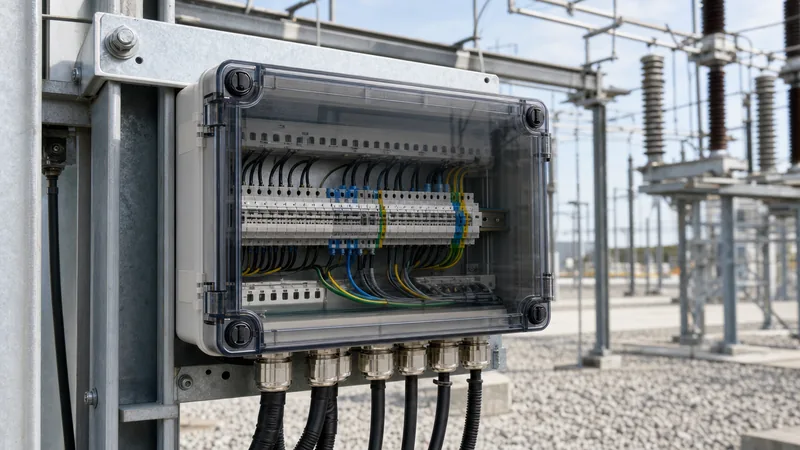
Quick answer: A plastic electrical junction box is an engineered non-metallic enclosure designed to house, protect, and terminate power, control, or instrumentation wiring against environmental ingress, mechanical impact, and chemical degradation. In industrial facilities and substation perimeters, non-metallic enclosures eliminate galvanic corrosion and remove the risk of touch voltage hazards on the enclosure body.
In high-voltage substations, industrial manufacturing plants, and utility distribution networks, auxiliary circuits require absolute reliability. While metal terminal cabinets serve main switchboards, auxiliary connections—such as current transformer (CT) marshaling, potential transformer (PT) signal routing, ambient temperature transducers, and perimeter low-voltage controls—routinely rely on engineered non-metallic enclosures. Selecting the correct plastic electrical junction box ensures that control loops remain shielded from moisture, ultraviolet degradation, and corrosive atmospheric pollutants.
Industrial engineers specify these enclosures to balance mechanical strength, chemical compatibility, and thermal performance. To explore broader enclosure classifications, review our guide to electrical enclosures and ingress protection, or examine specialised terminal housings in our outdoor terminal box selection guide.
Material Selection: Polycarbonate, PVC, ABS, and GRP Compared
Material formulation determines whether an enclosure maintains dielectric integrity and structural rigidity under thermal and environmental stress. When engineers specify electric junction boxes for industrial infrastructure, the four primary non-metallic materials are polyvinyl chloride (PVC), polycarbonate (PC), acrylonitrile butadiene styrene (ABS), and glass-reinforced polyester (GRP, also referred to as fiberglass-reinforced plastic or FRP).
A standard pvc outdoor electrical box offers resistance to salt spray, acids, and alkalis, making it suitable for direct-burial transitions and chemical processing perimeters. However, PVC exhibits a low heat distortion threshold, softening above 60°C, and becomes brittle at temperatures below -10°C. For heavy-duty industrial switchyards and unit substations, polycarbonate and GRP provide substantially higher physical resilience. Polycarbonate provides high impact resistance up to IK10 per IEC 62262, while GRP provides superior dimensional stability across broad thermal cycling ranges.
| Material Type | Tensile Strength (MPa) | Continuous Temp. Range (°C) | Impact Rating (IEC 62262) | Flame Retardancy (UL 94) | UV Resistance (UL 746C) |
|---|---|---|---|---|---|
| PVC (Polyvinyl Chloride) | 40 - 55 | -15 to +60 | IK07 to IK08 | V-0 | Moderate (requires stabilisers) |
| ABS | 35 - 50 | -25 to +70 | IK06 to IK07 | HB to V-1 | Poor (indoor use primarily) |
| Polycarbonate (Unfilled) | 60 - 75 | -40 to +120 | IK08 to IK09 | V-2 to V-0 | Good (with UV absorber) |
| Polycarbonate (10% Glass) | 80 - 105 | -40 to +130 | IK09 to IK10 | V-0 | Excellent (f1 rated) |
| GRP / FRP (SMC/BMC) | 70 - 120 | -50 to +150 | IK10 | V-0 | Excellent (f1 rated) |
For applications adjacent to outdoor power transformers or prefabricated substations documented in our unit substation engineering guide, glass-reinforced polycarbonate or compression-moulded GRP should be specified to withstand ambient temperature extremes and solar radiation without warping.
Ingress Protection and Environmental Ratings for Outdoor Applications
Ingress protection ratings define the ability of an enclosure to prevent the entry of solid foreign objects and pressurised water under standardised test conditions. In an outdoor plastic electrical junction box, environmental survivability relies on the gasket system, latching pressure, and mould design.
IEC 60529 classifies enclosure sealing using the IP code. For substation switchyards and industrial process areas, the minimum entry specification is IP66, which guarantees protection against dust and high-pressure water jets from any direction (100 kPa at a distance of 3 metres with a 12.5 mm nozzle). Where boxes face seasonal flooding, snow accumulation, or continuous washdowns, IP67 (immersion up to 1 metre for 30 minutes) or IP68 (continuous immersion under manufacturer-specified head pressure) is required. In North American specifications governed by NEMA 250, these correspond to Type 4X (corrosion-resistant, hose-directed water) and Type 6P (prolonged submersion).
Gasket composition directly governs seal longevity. Formed-in-place polyurethane (PUR) gaskets provide excellent memory retention across -40°C to +80°C. For extreme thermal variations or petrochemical exposure, fluorosilicone or continuous ethylene propylene diene monomer (EPDM) hollow-core gaskets are mandatory. Outdoor non-metallic enclosures must also comply with UL 746C code (f1), certifying that the polymeric resin has undergone 1,000 hours of xenon-arc weathering and water immersion without losing more than 15% of its tensile or impact strength.
Internal Sizing and Box Fill Calculations under NEC and IEC Standards
Internal volume sizing prevents conductor insulation damage, excessive internal temperature rise, and mechanical crowding during assembly and maintenance. Sizing a plastic electrical junction box requires rigorous application of National Electrical Code (NEC / NFPA 70) Article 314 or IEC 60670-1.
Under NEC Article 314.16(B), internal volume calculations allocate a specific cubic-centimetre allowance for each conductor entering the box, based on American Wire Gauge (AWG). The formula sums the volume allowances for conductors, internal clamps, support fittings, terminal blocks, and equipment grounding conductors:
- Conductor Volume: Each continuous conductor passing through, or terminating within, the box counts as one volume allowance per Table 314.16(B).
- Internal Cable Clamps: One allowance based on the largest conductor present, regardless of clamp count.
- Equipment Grounding Conductors: One allowance based on the largest grounding conductor (plus an additional 25% allowance for each ground conductor beyond four under recent NEC revisions).
- Terminal Blocks: Treated as devices requiring a double volume allowance based on the largest conductor terminated on the block.
Worked sizing example: Calculate the required internal volume for an outdoor transition box terminating two 4-core control cables containing 2.5 mm² (14 AWG) copper conductors, including four pass-through conductors, four terminated conductors on a DIN-rail block, two cable glands, and one internal ground bonding block.
- Eight 14 AWG circuit conductors: 8 × 32.8 cm³ (2.00 in³) = 262.4 cm³
- Terminal block allowance (double conductor volume): 2 × 32.8 cm³ = 65.6 cm³
- Grounding conductor allowance: 1 × 32.8 cm³ = 32.8 cm³
- Total minimum required volume: 262.4 + 65.6 + 32.8 = 360.8 cm³ (22.0 in³)
Applying a safety margin of 25% to account for conductor bending radii per NEC 314.28 yields a specified minimum enclosure volume of 451 cm³. In switchboard integration, adherence to IEC 61439 design rules also demands that total power dissipation inside the box does not exceed the thermal dissipation capacity of the enclosure walls at the specified maximum ambient temperature.
Applications of the Plastic Electrical Junction Box in Substation Perimeters
Substation environments impose severe electrical and magnetic stresses that make non-metallic enclosures technically superior to steel equivalents in specific auxiliary roles. A high-voltage switchyard generates substantial electromagnetic fields during fault transients, switching events, and continuous high-current operations.
When single-core alternating-current (AC) power cables penetrate a metallic enclosure wall, the alternating magnetic field induces circulating eddy currents in the surrounding conductive steel, causing severe localized induction heating per IEC 60364-5-52. A plastic electrical junction box eliminates magnetic hysteresis and eddy currents entirely, allowing single-core cables to enter without requiring non-magnetic brass or aluminum gland plates.
Typical substation installations deploy these non-metallic units for:
- Current Transformer (CT) and Voltage Transformer (VT) Secondary Marshaling: Housing shorting terminal blocks where galvanic separation from ground planes prevents circulating stray currents.
- Transformer Monitoring and Tap-Changer Control: Enclosing top-oil RTD temperature transducers, pressure-relief microswitch wiring, and winding temperature indicator transmitters.
- Battery Energy Storage and Solar Combiner Interfaces: Acting as intermediate electric junction boxes for DC string monitoring and thermal management sensors where DC voltages up to 1500 V require reinforced double insulation per IEC 62109-1.
- Perimeter Security and Fiber-to-Copper Transitions: Guarding remote I/O telemetry modules against outdoor lightning-induced ground potential rise (GPR).
Cable Gland Integration, Grounding, and Mechanical Mounting
Maintaining ingress protection and structural integrity requires correct drilling, gland integration, and mounting methods. Because non-metallic walls are non-conductive, grounding techniques differ fundamentally from metallic enclosures.
When installing a pvc outdoor electrical box or polycarbonate housing, penetration holes must be machined using step drills or hole saws at controlled feed rates to avoid micro-fracturing the polymer matrix. Threaded cable glands (metric ISO 965 or NPT) should be fitted with chloroprene or EPDM sealing washers on the external face. For unthreaded clearance holes, internal locknuts must be tightened to the gland manufacturer's torque limits—typically 4.0 to 7.5 Nm for standard metric nylon glands. Over-torquing strips plastic threads and deforms the sealing washer, causing liquid ingress.
Ground continuity requires dedicated engineering attention. When steel wire armoured (SWA) or braided cables enter a plastic electrical junction box, the armouring must be electrically bonded. Installers must use brass or stainless steel earth tags (banana tags) fitted over the gland threads inside the box, interconnected via a copper busbar or green-and-yellow earth continuity conductor rated for the prospective earth fault current per IEC 60364-5-54 Table 54.2.
Direct wall mounting through the internal base of an enclosure compromises ingress protection if screw heads penetrate the sealed compartment. High-reliability installations utilize external stainless steel (grade 316) mounting brackets fixed to rear moulded lugs, or utilize separate internal mounting channels isolated from the environmental seal.
Specification and Factory Inspection Checklist for Industrial Procurement
A structured procurement checklist eliminates site-level installation failures by verifying compliance before equipment leaves the factory floor. Engineers should incorporate the following inspection points into technical requisitions for non-metallic electric junction boxes.
- Material Certification: Mill test reports confirming base resin type, glass-fibre percentage (if applicable), and UL 94 flame class verification (minimum V-1, preferably V-0).
- Environmental Validation: Documentation of UL 746C (f1) weathering compliance for direct sunlight installations, and salt-mist test reports per IEC 60068-2-11 for coastal yards.
- Dimensional Verification: Wall thickness uniformity measurements using ultrasonic gauges, ensuring compliance with minimum thickness specifications (typically ≥ 3.0 mm for industrial enclosures).
- Gasket Quality and Adhesion: Verification that gaskets are either robotically dispensed continuous polyurethane or mechanically seated vulcanised neoprene profiles without manual butt-joint gaps.
- Fastener Metallurgy: All external hinge pins, screws, and captive cover fixings must be certified AISI 304 or AISI 316 stainless steel with captive retaining washers.
- Impact Proofing: Verification of type-test reports certifying mechanical impact ratings according to IEC 62262 (IK08 minimum for light industrial, IK10 for exposed outdoor substations).
- Dielectric Testing: Factory verification of surface resistivity (≥ 10¹² Ω per ASTM D257) and insulation resistance testing at 1,000 V DC between internal live components and the external surface.
Next steps: specifying and sourcing
Specifying the optimal plastic electrical junction box requires balancing environmental exposure, thermal loads, internal volume limits, and mechanical impact requirements. Whether configuring auxiliary marshaling for a complete prefabricated transformer substation or designing low-voltage controls within industrial switchgear assemblies, our engineering team provides complete technical verification, CAD layout drawings, and factory-drilled enclosure options.
Send your terminal counts, single-line diagrams, ambient operating parameters, and ingress protection specifications directly to our design team via our request a quotation portal or through the engineering contact page for detailed application support.
Frequently asked questions
Why use a plastic electrical junction box instead of metal?
A plastic electrical junction box provides complete galvanic isolation, will not corrode in acidic or saline environments, and eliminates circulating eddy currents caused by single-core AC conductors. It also prevents touch-voltage hazards by removing the need for external enclosure bonding.
Can a pvc outdoor electrical box be used in direct sunlight?
A pvc outdoor electrical box can be used in direct sunlight only if the resin incorporates ultraviolet stabilizers certified to UL 746C with an (f1) weathering rating. Unstabilised PVC becomes brittle, discolours, and loses impact strength under prolonged solar UV radiation.
How do you maintain electrical earth continuity in plastic electric junction boxes?
Earth continuity is maintained by fitting internal metallic earth tags (earth continuity rings) directly beneath the cable glands. These tags are connected together and linked to the facility ground via an internal copper bonding jumper sized according to IEC 60364-5-54.
What IP rating is required for an outdoor plastic electrical junction box?
An outdoor plastic electrical junction box should have a minimum rating of IP66 to prevent dust ingress and resist powerful water jets. Installations subject to temporary flooding, heavy snowpack, or continuous chemical washdown require IP67 or IP68 ratings.
What is the difference between polycarbonate and GRP junction boxes?
Polycarbonate is a thermoplastic material offering high optical clarity for inspection covers and exceptional impact resistance up to the highest impact ratings across moderate temperatures. Glass-reinforced polyester (GRP) is a thermoset composite that provides superior chemical resistance, higher mechanical rigidity, and continuous service temperatures up to 150°C.
Tags: plastic electrical junction box electric junction boxes pvc outdoor electrical box switchgear enclosures substation engineering