Key takeaways
- A professional transformers writer authors technical specifications, datasheets, and tender documents aligning IEC 60076 and IEEE C57 standards for utility procurement.
- The 1st transformer with a modern closed magnetic circuit was patented in 1885 by Hungarian engineers Károly Zipernowsky, Miksa Déri, and Ottó Bláthy at the Ganz factory.
- William Stanley built the first practical commercial AC distribution network utilising step-down transformers in Great Barrington, Massachusetts, in 1886.
- Procurement schedules written by engineering specialists must stipulate no-load loss tolerances within 15% and total loss tolerances within 10% per IEC 60076-1 clause 10.
- Factory acceptance testing protocols authored for heavy electrical contracts require strict adherence to lightning impulse withstand levels governed by IEC 60076-3 Table 2.
Quick answer: In heavy electrical engineering, a transformers writer is a technical specification engineer who authors procurement specifications, datasheets, and tender schedules in compliance with IEC 60076 or IEEE C57 standards. This discipline bridges the historical engineering principles established during the development of the 1st transformer in 1885 with modern manufacturing tolerances, loss guarantees, and dielectric insulation requirements.
Authoring a legally binding, technically rigorous transformer specification requires a comprehensive understanding of core metallurgy, thermal dissipation, short-circuit withstand capabilities, and international regulatory frameworks. Whether preparing an engineering, procurement, and construction (EPC) tender or reviewing vendor documentation, the precision of the specification author directly dictates equipment longevity and factory compliance. To understand the procurement requirements for bespoke industrial designs, consulting our Custom Transformer Procurement Guide provides valuable engineering context.
What Year Was Transformers Made and Who Produced Transformers First?
The technical foundation of electromagnetic voltage conversion dates back to 1831, but practical commercial devices emerged five decades later. Answering what year was transformers made requires distinguishing between early laboratory induction coils and closed-core AC apparatus. In 1885, Hungarian engineers Károly Zipernowsky, Miksa Déri, and Ottó Bláthy at the Ganz company developed and patented the 1st transformer utilising a closed toroidal iron core, coining the engineering term itself.
For those researching who produced transformers on a commercial grid scale, George Westinghouse financed and refined the design in the United States. Following the Ganz patents and Lucien Gaulard and John Dixon Gibbs's open-core patents of 1882, American inventor William Stanley produced the first operational step-down AC distribution system in Great Barrington, Massachusetts, in March 1886. Stanley used a parallel-connected, E-shaped sheet-iron core operating at 500 V primary and 100 V secondary. This historical milestone marked the transformers first release into municipal electrification networks, establishing the alternating current distribution architecture still deployed globally today.
The Core Role of a Transformers Writer in Industrial Procurement
A modern transformers writer formulates the technical schedule, performance guarantees, and inspection parameters that govern high-voltage manufacturing contracts. Without an exhaustive engineering specification, project developers risk receiving standard commercial equipment that fails to endure system harmonic distortion, seismic forces, or transient overvoltages. The specification writer must translate site-specific operating environments into strict numerical boundaries.
Key responsibilities assigned to an electrical specification writer include:
- Defining site ambient ratings, altitude de-rating factors per IEC 60076-1 clause 5.4, and seismic zone accelerations (e.g. 0.3g ground acceleration according to IEEE 693).
- Establishing winding material constraints, core steel grades (such as grain-oriented silicon steel vs amorphous metal), and insulation thermal classes.
- Determining the required vector group (e.g. Dyn11 for low-voltage four-wire distribution or YNd11 for transmission step-up applications).
- Setting capitalization formulas for no-load losses ($/kW) and load losses ($/kW) to evaluate competitive manufacturer bids over a 30-year operational lifecycle.
- Drafting testing regimes aligned with our comprehensive overview of Power Transformer Testing Procedures.
Historical Evolution: From the 1st Transformer to Modern Solid-Core Units
A concise transformers summary illustrates how magnetic circuit geometry and dielectric systems evolved from nineteenth-century prototypes to today's multi-MVA units. Early devices suffered from extreme eddy current heating and high excitation currents due to solid unlaminated iron structures. The transition to insulated silicon steel laminations in the early 1900s dramatically reduced hysteresis and parasitic losses.
When researching who wrote transformers specifications in the early twentieth century, national bodies such as the British Engineering Standards Association (later BSI) and the American Institute of Electrical Engineers (AIEE, now IEEE) established the first unified standardization documents between 1910 and 1925. Understanding this evolution helps modern engineers choose between cast-resin insulation covered in our Dry Type Transformer Guide and conventional liquid-immersed topologies.
| Historical Era | Key Milestone & Innovator | Core Construction | Insulation / Cooling | Efficiency Level |
|---|---|---|---|---|
| 1882–1884 | Gaulard & Gibbs (Series Inductors) | Open magnetic core, iron wires | Paraffin, shellac cloth, air | Below 70% |
| 1885 (1st Transformer) | ZBD Team (Ganz Company) | Closed-circuit toroidal iron wire | Natural air cooling, oil glaze | 85% – 88% |
| 1886 (First Commercial Release) | William Stanley / Westinghouse | Laminated E-shaped iron plates | Air / cotton / paper layers | Above 90% |
| 1930s–1950s | Cold-rolled grain-oriented (CRGO) steel | Interleaved stacked laminations | Mineral oil (Class O, 105°C) | 97.5% – 98.5% |
| Modern Era (2020s+) | Laser-scribed CRGO & Amorphous Metal | Step-lap mitered core joints | Mineral oil, synthetic esters, Nomex | 99.2% – 99.7% |
Writing Technical RFQ Schedules: A Transformers Writer Specification Matrix
When generating an engineering procurement package, the specification author must supply an unequivocal requirements schedule. Factory tendering departments require precise figures to calculate copper weight, core cross-sectional area, and tank dimensions without relying on arbitrary assumptions. The table below outlines the core parameters that every specification engineer must complete prior to issuing an RFQ.
| Technical Parameter | Reference Standard | Typical Industrial Specification Range | Engineer Verification Focus |
|---|---|---|---|
| Rated Power (kVA/MVA) | IEC 60076-1 / IEEE C57.12.00 | 500 kVA to 63 MVA (Base rating ONAN/KNAN) | Verify future load growth and de-rating |
| Nominal Voltage Ratio | IEC 60076-1 Clause 6 | 11 kV / 0.433 kV, 33 kV / 11 kV, 110 kV / 33 kV | Confirm system tapping margins and tolerances |
| Winding Material | IEC 60076-5 | Electrolytic copper (Cu) or Electrical grade aluminium (Al) | Check short-circuit thermal withstand limits |
| Impedance Voltage (%Z) | IEC 60076-1 Table 1 | 4.0% to 12.5% at rated base MVA | Balance fault current limits against voltage drop |
| Basic Impulse Insulation Level (BIL) | IEC 60076-3 Table 2 | 75 kV (for 11 kV) up to 550 kV (for 110 kV) | Coordinate with surge arrester protective levels |
| Tap Changer Range | IEC 60214-1 | Off-Circuit: ±2×2.5%; On-Load (OLTC): ±8×1.25% | Verify step voltage and transient switching duty |
| Loss Capitalization ($/kW) | Customer Standard / IEEE C57.120 | No-load: $4,000–$8,000/kW; Load: $1,200–$2,500/kW | Evaluate total cost of ownership across lifecycle |
Loss Capitalization Calculation for the Specification Engineer
A critical responsibility of an engineering transformers writer is establishing financial evaluation formulas for factory test tolerances. Total Ownership Cost (TOC) ensures that bids offering lower upfront purchase costs do not mask excessive electrical losses over a 25-year operational window. IEC 60076-1 clause 10 dictates that no-load losses must not exceed guaranteed values by more than +15%, while total losses cannot exceed +10%.
Consider an RFQ for a 2,500 kVA, 33/0.415 kV substation transformer. The specification author sets the TOC formula as follows:
- Formula: TOC = Purchase Price + (A × No-Load Loss in kW) + (B × Load Loss in kW)
- Evaluated Capitalization Factors: Factor A (No-load) = $6,200 / kW; Factor B (Load loss) = $1,800 / kW
- Manufacturer Bid 1: Price = $48,000; Po (No-load) = 2.4 kW; Pk (Load loss at 75°C) = 21.0 kW
- Manufacturer Bid 2: Price = $53,000; Po (No-load) = 1.8 kW; Pk (Load loss at 75°C) = 17.5 kW
Evaluating Bid 1: TOC = $48,000 + (2.4 × 6,200) + (21.0 × 1,800) = $48,000 + $14,880 + $37,800 = $100,680.
Evaluating Bid 2: TOC = $53,000 + (1.8 × 6,200) + (17.5 × 1,800) = $53,000 + $11,160 + $31,500 = $95,660.
Although Bid 2 has a purchase price $5,000 higher, its superior core and conductor engineering results in a net saving of $5,020 over the evaluated operating period. To explore balanced core geometry and configuration across polyphase units, refer to our detailed 3 Phase Transformer Guide.
Factory Inspection and FAT Protocol Authoring Guide
A robust procurement document drafted by an experienced transformers writer must enforce mandatory hold points during factory fabrication and Factory Acceptance Testing (FAT). Failure to define these stages permits suppliers to dispatch units without independent third-party witness verification of critical dielectric and mechanical properties.
The specification author should structure the quality assurance protocol into the following ordered milestones:
- Stage 1: Design Review and Raw Material Certification: Validate mill test certificates for core steel laminations (loss per kg at 1.7 Tesla), copper conductor conductivity (IACS minimum 100%), and dielectric insulating fluid properties according to IEC 60296.
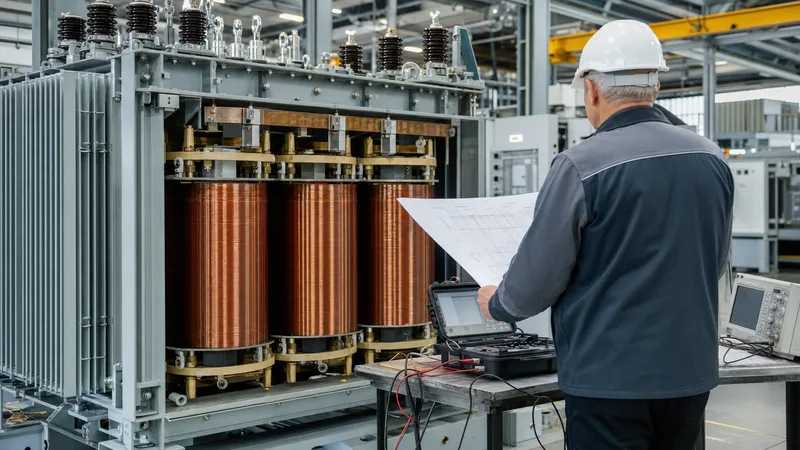
- Stage 2: Core Assembly and Pre-Tanking Inspection: Inspect the core stacking pattern (45-degree full miter step-lap joints), burr heights (maximum 0.02 mm), core ground connection insulation, and winding axial clamping pressures prior to tank insertion.
- Stage 3: Routine and Dielectric Factory Acceptance Tests: Execute all routine tests stipulated by IEC 60076-1, including winding resistance measurement, voltage ratio verification, vector group checks, and no-load/load loss tests at rated frequency.
- Stage 4: Dielectric Withstand Testing: Perform separate source AC withstand voltage testing and induced AC withstand voltage (IVW) testing with partial discharge monitoring to ensure levels remain below 100 pC at 1.5 Um / √3 per IEC 60076-3.
- Stage 5: Final Tank and Pressure Tightness: Subject the sealed transformer to a hydrostatic pressure test at 50 kPa above normal head for 24 hours to guarantee absolute hermetic integrity before export packaging.
Next steps: specifying and sourcing
To begin a formal procurement cycle, prepare your single-line diagram, nominal primary/secondary distribution voltages, required impedance percentage, and specific loss capitalization formulas. Our engineering design team reviews your complete technical schedules to manufacture custom power transformers, highly efficient oil-immersed transformers, and robust dry-type transformers engineered precisely to IEC, IEEE, and ANSI international benchmarks. For a detailed engineering appraisal or commercial tender evaluation, visit our transformer quotation page or reach out directly via our engineering contact page.
Frequently asked questions
what year was transformers made
The modern alternating current transformer with a closed magnetic core was developed and patented in 1885 by Károly Zipernowsky, Miksa Déri, and Ottó Bláthy at the Ganz factory in Hungary. Commercial scale municipal deployments followed in 1886 through William Stanley and George Westinghouse in the United States.
who produced transformers commercially first
The Ganz company in Budapest produced the first commercial closed-core transformers in 1885. In North America, the Westinghouse Electric Corporation produced the first commercial alternating current distribution transformer system in 1886, engineered by William Stanley.
who wrote transformers engineering specifications first
Early standardisation rules and engineering specification guides were authored between 1910 and 1925 by the American Institute of Electrical Engineers (AIEE, now IEEE) and the British Engineering Standards Association (now BSI) to establish uniform insulation ratings, temperature rise limits, and loss measurement methodologies.
what does a transformers writer do in electrical procurement
A transformers writer is an electrical technical author or consulting engineer who drafts equipment specifications, tender schedules, and testing regimes. They ensure manufacturer bids comply with international standards such as IEC 60076 and IEEE C57 while balancing loss capitalisation, impedance tolerances, and operating environmental constraints.
what is the importance of a transformers summary in an RFQ
A transformer summary schedule consolidates electrical ratings, BIL levels, thermal temperature rises, vector configurations, and factory acceptance testing hold points into an unambiguous matrix. This schedule guarantees that bidding factories provide compliant design calculations and accurate loss guarantees without costly scope gaps.
Tags: transformers writer who produced transformers what year was transformers made 1st transformer transformers summary